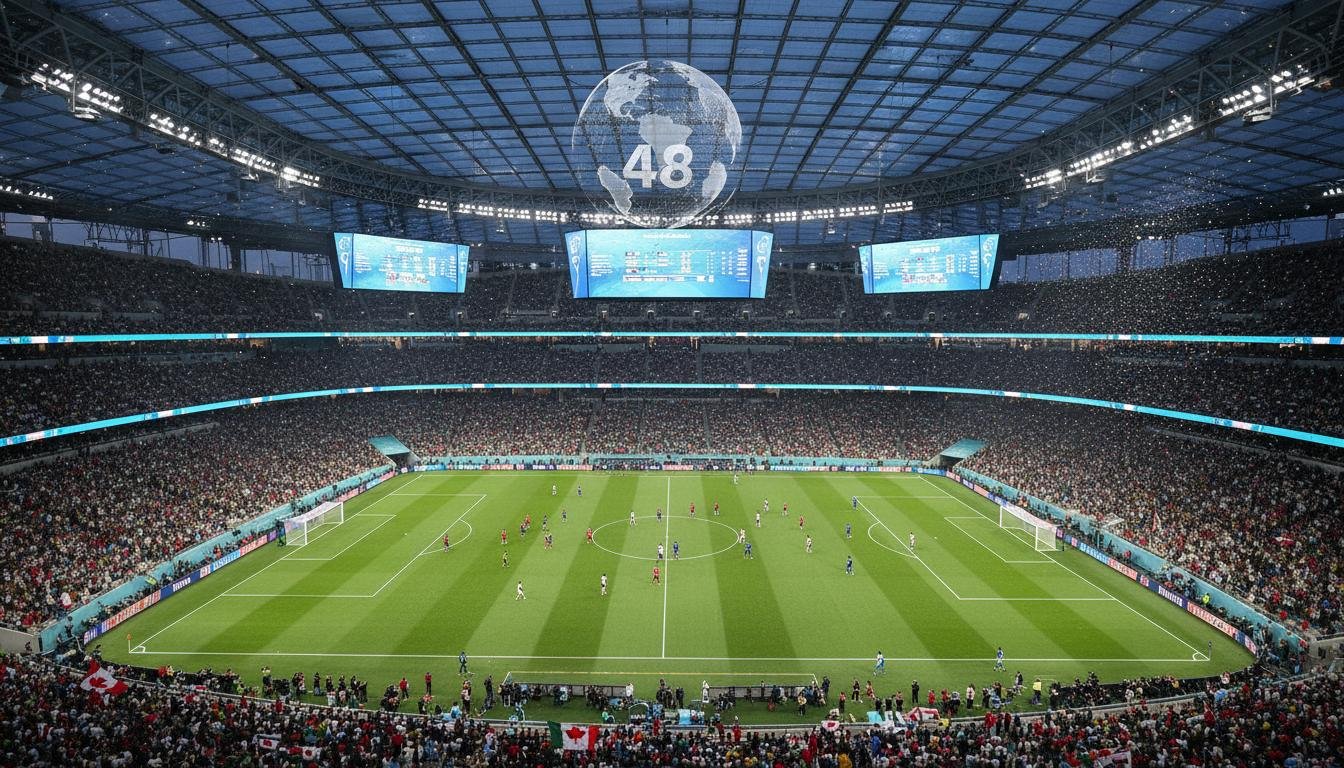
The 2026 World Cup will be unlike any tournament modern fans have seen: larger fields, three host countries, and a new tactical landscape shaped by richer data streams. Using historical patterns, public forecasting models, and competition design, we can pull out realistic trends and practical predictions about how the event is likely to play out.
How the expanded format reshapes competition
FIFA’s expansion to 48 teams — organized into 16 groups of three, with the top two advancing to a round of 32 — changes incentives and variance in measurable ways. Smaller groups mean fewer matches per team in the group stage, amplifying the impact of single results and raising the value of goal difference and in-game management.
From a data perspective, that format increases the probability of surprise qualifiers and creates more high-leverage moments. Models that simulate tournaments (Elo-based or Poisson shot models) show that fewer group games typically boost upset rates because a single unlikely win or loss swings qualification more dramatically than in four-team groups.
Expected scoring and the influence of analytics
Over recent cycles, measured metrics such as expected goals (xG) and pressing intensity have become standard in evaluating teams and strategies. Teams that optimize shot quality rather than sheer shot volume tend to outperform expectations in knockout settings, as quality shots are rarer under tournament pressure.
Because the 2026 field includes more mismatched contests in early rounds, aggregate goals per match should rise slightly, driven by stronger teams facing lower-ranked sides. Simultaneously, analytics-driven coaching—lineup rotation informed by load data and downstream tactics like coordinated pressing—will compress variance in later rounds, favoring teams that invest in data infrastructure.
Which regions stand to gain
Geography matters. A North American World Cup spreads games across long distances and across different climates, which benefits squads with deep rosters and experience managing travel. CONCACAF nations will enjoy relative home advantages in terms of fan presence and short travel when games stay within their borders.
Meanwhile, African and Asian teams have been closing the gap in measurable metrics like conversion rate and defensive actions per 90 minutes. Coupled with the expansion offering more slots to underrepresented confederations, expect deeper runs from at least one team outside the traditional European-South American power axis.
Player trajectories: veteran decline and youth emergence
Player-level data consistently show that peak performance in physical metrics tends to cluster between ages 24 and 29, with creativity and reading of the game persisting later for some attackers and midfielders. By 2026, several household names will be past their physical peaks, which matters because tournaments reward explosive recovery and high-intensity pressing.
This creates space for the next generation. Clubs that give youngsters regular minutes in top leagues provide measurable preparation for international tournaments. Look for young forwards with strong xG per 90 and midfielders with high progressive pass metrics to be tournament accelerants — players who change matches even if they are not global stars yet.
Modeling contenders: what data-driven forecasts tend to agree on
Different forecasting systems (Elo ratings, SPI, Poisson-based shot models) use varied inputs but often converge on a handful of consistent factors: recent head-to-head, goal differential in qualifiers, player availability, and club-season minutes. When models differ, it’s usually because of weightings on form versus historical quality.
Rather than quoting a single probability, the prudent conclusion from multiple model outputs is this: established powerhouses with stable talent pipelines remain favorites, but the effective field of legitimate contenders widens under the 48-team format. Upsets are likelier in group play; depth matters in the knockout rounds.
Dark horses and tactical profiles to watch
History and data suggest that dark-horse candidates come from teams that combine disciplined defense (low xG conceded) with opportunistic transition metrics (high xG per counter-attack). Those profiles withstand the pressure of knockout play better than high-possession teams that lack clinical finishing.
Teams that adopt fluid formations and rotate players without losing defensive structure will outperform expected outcomes. Keep an eye on nations that have recently invested in youth academies and analytics departments; their incremental gains add up over qualifying cycles and show up in tournament performance.
Travel, scheduling and the non-quantifiable edge
Logistics is a data point often relegated to footnotes, but travel distance, recovery time between matches, and local climate all correlate with measurable declines in sprint volume and pass accuracy. In a continent-sized tournament, those small percentage effects accumulate and favor squads that can manage rotation and rapid recovery.
I remember covering a club trip in North America where a single cross-country flight reduced players’ high-intensity running the following match; that micro-example mirrors what national teams will face in 2026. Teams that plan for sleep, nutrition, and rotation will turn logistical headaches into a competitive advantage.
Betting and fan use of models: practical guidance
Models are tools, not oracles. They provide probabilities conditional on assumptions about injuries, starting lineups, and referee tolerance for physical play. A wise fan or bettor uses model output to identify mismatches between public perception and quantified expectation, not to chase long-shot certainty.
Pay attention to how models update after key events: a red card appeal, a late injury, or a surprise tactical shift. Those items matter disproportionately in short-format group play. Diversifying bets across correlated events and favoring market inefficiencies—like underrated defensive teams in single-elimination legs—yields better long-term returns than flashy long shots.
How to interpret predictions responsibly
Every prediction carries uncertainty. Ensemble approaches that combine Elo-style ratings, expected-goals models, and market-implied probabilities tend to outperform single-method forecasts because they hedge methodological bias. Look for consensus, not certainty.
Data helps you understand ranges of plausible outcomes. Expect more variance in group-stage qualification and more convergence in late knockout rounds. Fans who embrace probabilistic thinking will enjoy the tournament more and interpret surprises as part of the process rather than failures of prediction.
Quick reference: tournament format snapshot
| Feature | Detail |
|---|---|
| Teams | 48 |
| Group stage | 16 groups of 3 (top two advance) |
| Knockout | Round of 32 followed by standard single-elimination |
| Hosts | United States, Canada, Mexico |
That snapshot is useful when comparing tournament simulations: small differences in group rules translate into larger changes in predicted advancement probabilities for borderline teams.
Final thoughts before kickoff
Data doesn’t remove drama; it frames it. The 2026 World Cup will reward adaptability, squad depth, and smart use of analytics while increasing the chances for unlikely stories early on. Fans should expect more goals in mismatched games, more tactical nuance from data-savvy coaches, and regional advantages for teams used to the travel and atmosphere of North America.
Watching how models update through qualification and the first rounds will be as informative as any pre-tournament forecast. When the matches begin, the data will keep telling the story—only this time with a louder chorus of surprises.
Sources and experts cited:
- FIFA — World Cup overview and official format information
- FiveThirtyEight — Soccer predictions and the SPI model
- World Football Elo Ratings — historical team strength model
- Stats Perform / Opta — performance data and analytics
- Transfermarkt — player age and club-minute datasets
- FIFA Technical Reports — tournament-level statistical analysis
- Academic summaries on home advantage and travel effects in sport (ScienceDirect)