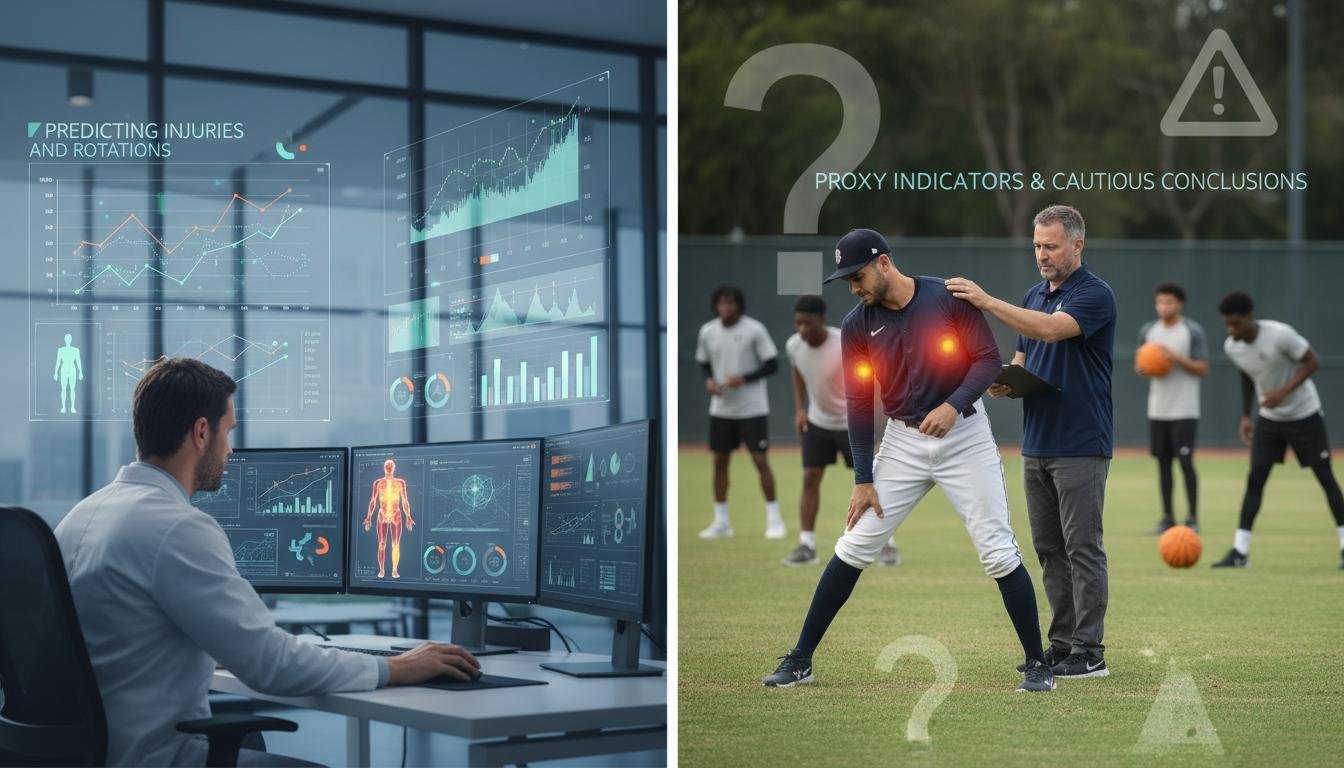
Predicting injuries and rotations: proxy indicators and cautious conclusions is a topic that lives at the intersection of medicine, analytics, and intuition. Teams, clinicians, and analysts all want to reduce harm and keep rosters available, but the data rarely speak in certainties. What follows is a practical examination of the proxies commonly used to infer injury risk or impending lineup changes, their strengths and weaknesses, and a framework for making cautious, defensible decisions.
What we mean by proxy indicators
A proxy indicator is a measurable signal that stands in for something harder to observe directly — for example, using a spike in weekly workloads as a proxy for elevated injury risk. Proxies are attractive because they are often available in real time: GPS distance, pitch counts, soreness scores, sleep duration, and external workload metrics can all be logged continuously.
Because proxies are indirect, they require interpretation. A higher-than-usual workload could mean improved conditioning, a scheduling quirk, or a genuine increase in risk. The value of a proxy lies in context and in how it combines with other signals.
Common proxy indicators and what they actually tell
Teams and researchers most often rely on a handful of repeatable measures. Workload (acute versus chronic), subjective wellness reports, biomechanics from video or sensor data, and historical injury history are repeated across sports and levels. Each has utility but also blind spots.
Workload measures capture stress but not recovery; subjective reports capture felt state but can be biased; biomechanical deviations can indicate a developing compensation pattern yet may not predict an acute event. None of these indicators can, on its own, deliver a deterministic forecast.
| Proxy indicator | What it signals | Main caveat |
|---|---|---|
| Acute:chronic workload ratio | Recent load relative to longer-term baseline; spikes may correlate with risk | Context-dependent and sensitive to how ‘acute’ and ‘chronic’ are defined |
| Self-reported soreness/fatigue | Immediate perceived readiness and recovery | Subject to placebo, underreporting, and differing pain tolerances |
| Biomechanical markers (video/sensors) | Movement patterns that can precede overuse or compensatory injury | Requires expert interpretation and high-quality data |
| Historical injury and age | Baseline susceptibility for reinjury or cumulative decline | Doesn’t capture short-term fluctuations in status |
How predictive are these indicators really?
We should be frank: most proxies improve probabilistic assessment rather than deliver binary outcomes. Predictive models often show modest increases in risk discrimination when proxies are combined, but they fail to reach the kind of accuracy many stakeholders hope for. The area under the curve (AUC) for injury prediction models in the literature frequently lands in a range that is useful for population-level planning but unreliable for single-player, single-game calls.
Part of the problem is class imbalance — injuries are relatively rare events — which makes false positives and false negatives costly. Overfitting is another persistent danger: models tuned to a team’s historical data may not generalize to new seasons, different training regimens, or separate sports.
Real-world examples and lessons from the field
Covering teams and speaking with athletic trainers over the years, I’ve watched similar patterns repeat. A promising pitcher’s training log shows an upward spike in high-intensity throws; the analytics staff raises a flag, but the player reports feeling great. The coaching staff faces a choice between protecting an asset and maintaining competitive rotation integrity. Often the decision comes down to triangulation: workload, objective biomechanical drift, and medical exam findings together carry more weight than any one input.
One NFL team I followed moved from a rules-based approach (bench if a metric crosses a threshold) to a deliberative committee model — coach, medical director, performance analyst — to interpret signals. The result was fewer abrupt lineup shocks and clearer rationale for rest days, albeit at the price of slower, more conservative moves.
Best practices for analysts and clinicians
Successful programs treat proxies as part of a layered decision process. Start with data hygiene: consistent definitions for workload windows, standardized self-report tools, and sensor calibration. Combine objective and subjective measures and set decision thresholds that explicitly balance performance and risk.
Communicate uncertainty to stakeholders. When analysts present a risk assessment, include confidence intervals and clear explanations of the assumptions behind the model. This builds trust and avoids binary misinterpretations of probabilistic outputs.
Ethical, privacy, and human factors
High-resolution player monitoring creates ethical questions. Who owns the data? How is it used in contract negotiations or playing-time decisions? Consent and transparent governance reduce the chance that performance data becomes a weapon rather than a protection.
Human behavior matters too. If players fear that honest reporting will cost them playing time, they will underreport soreness. Nurturing an environment where players feel safe to disclose discomfort is as important as the analytics platform collecting the numbers.
A practical framework for cautious conclusions
Here is a simple workflow teams can adopt: (1) collect multiple orthogonal proxies, (2) flag deviations rather than rely on single thresholds, (3) convene a multidisciplinary review, (4) quantify the uncertainty and model assumptions, and (5) document the decision and follow-up plan. This sequence respects the limits of prediction while preserving actionability.
For single-game or rotation decisions, prefer short-term mitigations — modified workloads, increased monitoring, or targeted treatment — over draconian, roster-altering moves unless multiple signals and clinical exam clearly indicate high risk. The aim is conservative risk management, not risk avoidance at the expense of competitive integrity.
Where research should go from here
Improvements will come from better longitudinal datasets, transparent model reporting, and randomized trials where feasible — for example, studies that compare outcomes for players managed by algorithm-informed protocols versus standard practice. Cross-disciplinary collaboration between data scientists, clinicians, biomechanists, and ethicists will also sharpen both models and governance.
Until predictive tools consistently demonstrate high individual-level accuracy in peer-reviewed trials, practitioners should resist the temptation to treat proxies as oracle-like. Use them to inform, not to dictate.
In practice, the best decisions marry data, clinical judgment, and context. Predictive signals can save players from reinjury and help managers set realistic expectations, but treating proxy indicators as definitive will produce both false alarms and missed opportunities. The prudent path is transparent, multidisciplinary, and calibrated to uncertainty.
Sources and further reading
- PubMed — research on training load and injury
- British Journal of Sports Medicine (BJSM)
- American College of Sports Medicine (ACSM)
- American Journal of Sports Medicine (AJSM)
- Baseball Savant / Statcast (for rotation and pitching analytics)
- FanGraphs (analytics and roster decision reporting)
- NCAA Sport Science Institute