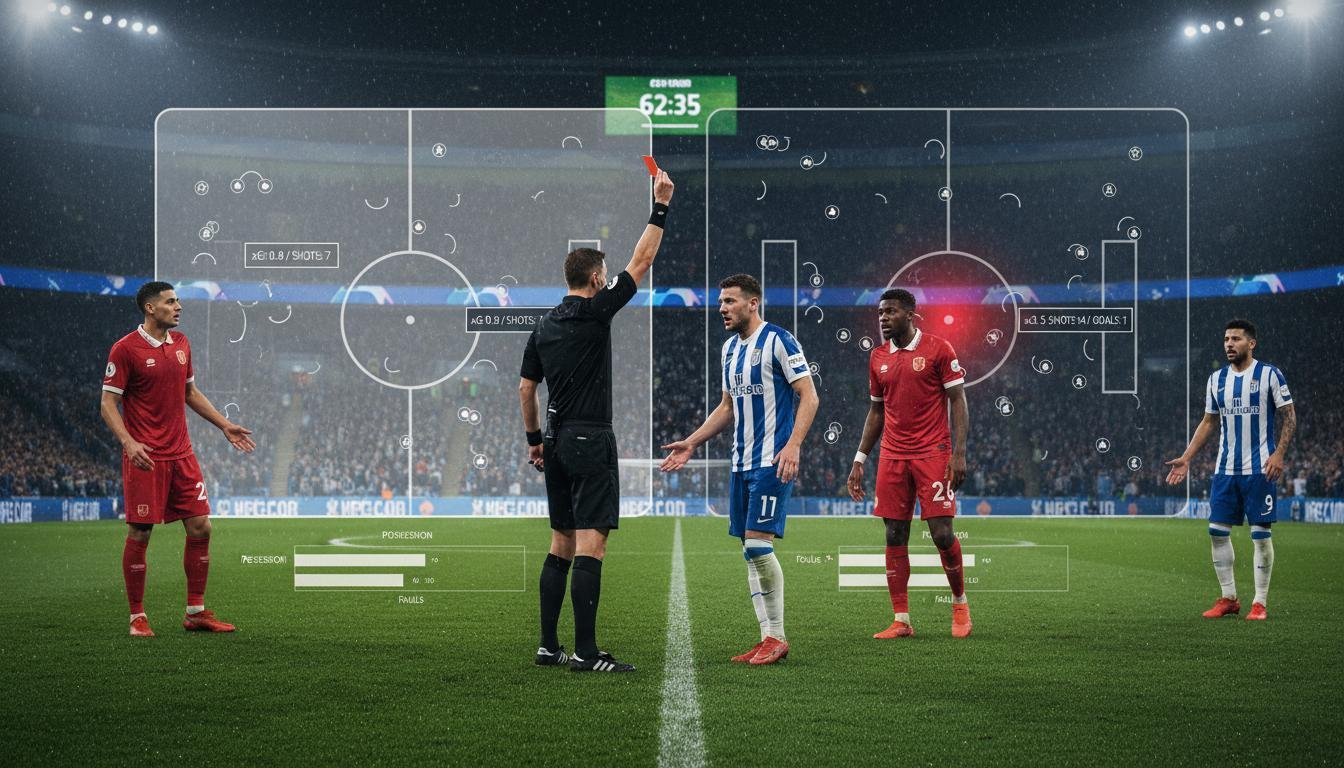
Red cards change a match faster than a substitution. A single dismissal reshapes tactics, tempo, and the flow of shots, which means any model that predicts goals — whether expected goals (xG) or match totals — should account for them. This article walks through practical, data-driven ways to fold red-card events into your xG pipelines and over/under forecasts, balancing statistical rigor with the messy realities of live football.
Why red cards matter for expected goals and totals
When a player is sent off the balance between attack and defense shifts. The team that loses a player usually sees fewer progressive actions, fewer high-quality shot locations, and a greater likelihood of conceding; the opposite is true for the opposition. These changes are not instantaneous or uniform, so naive adjustments — like subtracting a fixed number of goals — will misrepresent the true effect.
Red cards are interaction events: their impact depends on minute of the game, scoreline, player position, and whether the card is straight or a second yellow. A center-forward dismissed in the 85th minute affects scoring potential differently from a holding midfielder sent off in the 25th. Any robust model must therefore be conditional on context.
Data and preprocessing
Start with event-level data that includes timestamps for shots, passes, and cards. Providers such as StatsBomb and Opta give xG-tagged shot events and reliable card timing, which is essential for separating pre- and post-red-card states. Build a per-match timeline of xG accumulated minute-by-minute for both teams.
Label each match-minute with the current number of players on the pitch per team, the current scoreline, and other covariates like home advantage and possession share. This transforms a match into a sequence of states you can analyze with time-aware methods rather than a single static outcome.
Modeling approaches
Poisson and rate-based adjustments
Traditional football-score models treat goals as Poisson processes with different scoring rates for each team. A practical way to include red cards is to model a team’s scoring rate as a function of red-card state. After estimating baseline scoring rates from historical data, include multiplicative factors for “one-man down” and “one-man up.”
Fit these factors by comparing goal rates before and after red cards across many matches. That gives you a straightforward mechanism: when a red card happens live, multiply the team’s remaining expected goals per minute by the fitted rate ratio to get an updated forecast.
Survival analysis and in-play xG
Survival models (or Cox proportional hazards models) are well-suited for “time until next goal” questions. Treat goals as events and red cards as time-dependent covariates that alter the hazard. This approach naturally handles censoring and the varying length of remaining match time.
Survival methods let you estimate how a red card at minute t changes the instantaneous probability of either team scoring in the remaining period. Those hazard adjustments can be combined with per-shot xG to produce a refined probability distribution for final totals.
Machine learning and sequence models
If you prefer a nonparametric route, feed minute-by-minute features — player counts, recent xG momentum, pressure metrics — into gradient-boosted trees or recurrent networks. These models can learn nonlinear interactions, like how a red card affects teams differently depending on possession or fatigue metrics.
However, ML models need careful regularization: red cards are relatively rare, so a complex model can overfit to idiosyncratic events unless you augment training data or use hierarchical pooling across teams and seasons.
Practical implementation: step-by-step
1) Aggregate your dataset: collect match timelines, shot xG, card types, and contextual features such as score and minute. Split your data into training and validation windows to check for temporal drift.
2) Choose a modeling backbone: Poisson rate multipliers are simple and fast; survival models give time-aware probabilities; ML models capture complex interactions. It’s often productive to use two complementary methods and compare results in live tests.
3) Estimate red-card effects on scoring and conceding rates, stratified by minute buckets (e.g., 0–15, 16–45, 46–75, 76–90+). Use these empirical adjustments to alter per-minute xG accumulation after a red card.
4) Simulate the remainder of the match using the updated rates to produce a full distribution of possible final scores and totals. Monte Carlo simulation will give you probability mass across totals (e.g., 0–1 goals, 2 goals, 3+ goals).
How to handle heterogeneity: player, card type, and match state
Not all red cards are equal. Straight reds for violent conduct often remove key defenders and have larger tactical repercussions than a second yellow to a forward who has already been substituted mentally from the game. Include variables for card type and player role to let the model differentiate effects.
Scoreline matters too. A team leading by two goals after suffering a red card may switch to ultra-defensive behavior, reducing their own shot attempts but increasing counter-attacking chances for the rival. Represent this by interacting red-card indicators with current goal difference.
Calibration, evaluation, and sample-size caveats
Calibrate your post-red-card forecasts against holdout matches that contain red cards. Use Brier score and log loss for probabilistic accuracy, and measure calibration across probability bins. Also compare the predicted distribution of totals to observed frequencies after cards.
Because red cards are relatively uncommon, confidence intervals around your fitted multipliers will be wide, particularly for late-game cards or unusual player roles. Pooling effects across seasons, leagues with similar styles, or using hierarchical Bayesian priors can stabilize estimates.
Market and betting considerations
Bookmakers and live markets already price in red-card risk to some extent. Your model’s edge will come from fast, context-aware updates: updating xG by minute, accounting for the type of dismissal and team-specific responses, and simulating outcomes under the altered rates.
Exercise caution with liquidity and bookmaker margin. Even a model that correctly shifts probabilities after a red card can be vulnerable to large or irregular market adjustments, especially in low-liquidity matches or niche markets like exact goals for one team.
Example: an illustrative workflow
Below is a compact table showing the main components you’ll need to turn data into a live-adjusted xG and totals forecast. Numbers are illustrative; use your historical estimates to populate multipliers.
| Component | Purpose |
|---|---|
| Event timeline | Provides minute-by-minute xG and card timestamps |
| Red-card multipliers | Adjusts per-minute scoring/conceding rates after a dismissal |
| Simulation engine | Produces full-score distributions and totals probabilities |
| Calibration/monitoring | Tracks model performance and updates parameters |
Real-world experience and tips from modeling live games
In my own work building live models, I found that the minute of dismissal explains more variance than which player was sent off, but both matter. Early red cards (first half) tend to shift expected totals substantially, while dismissals after the 80th minute often only change the tail probabilities.
Another practical tip: log the model’s confidence. When you see wide uncertainty after infrequent card types (a straight red to a goalkeeper, for instance), present wider probability bands and avoid offering hard binary recommendations to traders or bettors.
Sources and experts
Below are authoritative resources and experts that informed the methods discussed. Consult their writings for deeper technical background on xG, event data, and statistical models used in sports analytics.
- StatsBomb — event data and analytics articles
- Opta / Stats Perform — event feeds and insight
- FiveThirtyEight soccer — public-facing models and commentary
- Dixon–Coles model (background on score modeling)
- Michael Caley — applied xG analysis and match-modeling commentary
Accounting for red cards is less a single trick and more of a disciplined pipeline: capture minute-level dynamics, estimate context-sensitive multipliers, simulate the rest of the match, and always quantify uncertainty. Do that, and your xG and totals forecasts will reflect the true volatility a red card injects into a game.