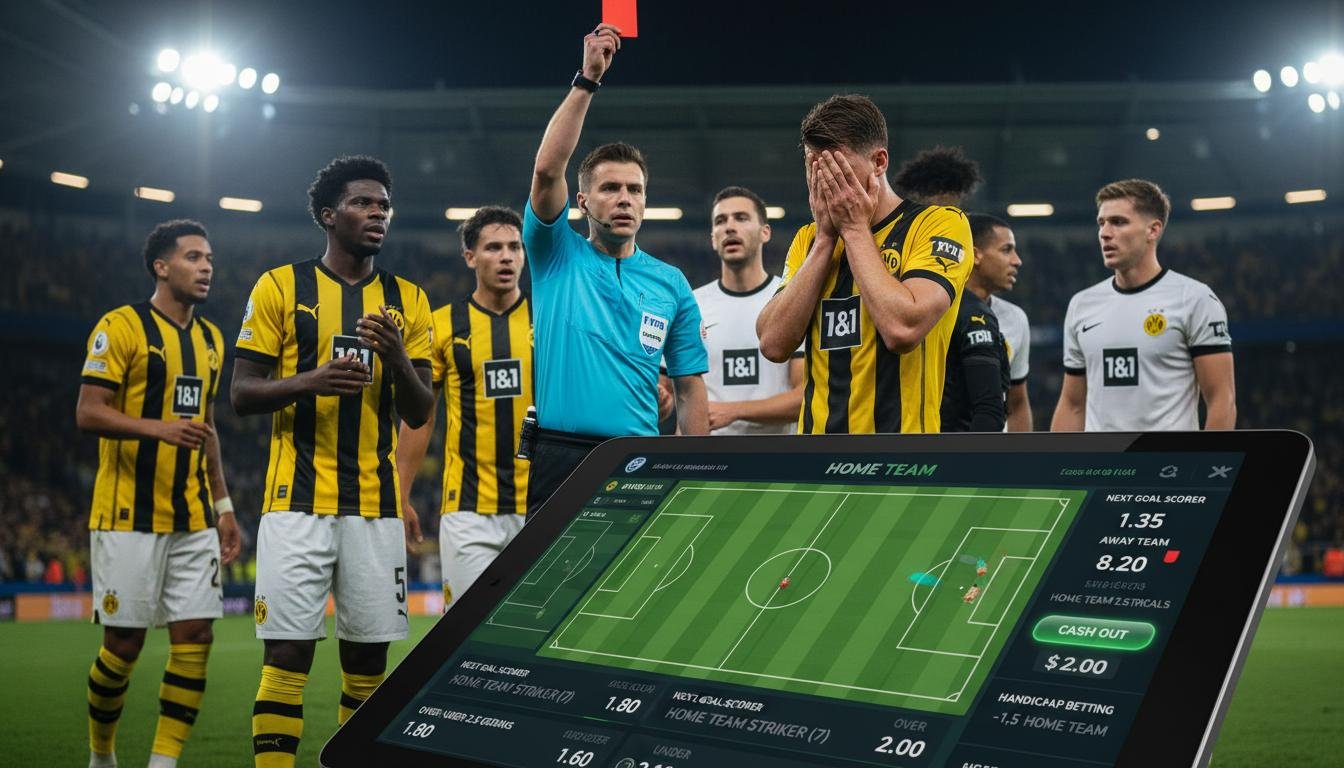
Red cards change more than the scoreline; they alter tempo, tactics, and the market’s appetite for risk. For anyone who bets live, a sending-off is a pivot point — a moment when odds shift, opportunities appear, and the wrong decision can be costly. This article walks through how to read the game after a dismissal, where value typically shows up, the timing considerations that matter most, and practical rules to protect your bankroll when the match turns chaotic.
What a red card actually does to a match
A red card reduces a team to ten men and forces immediate tactical rebalancing. Managers usually choose between retreating to shore up defense or keeping shape and risking space in midfield; the choice depends on the scoreline, remaining time, and the player sent off.
The on-field effects are measurable: possession often shifts toward the team with the numerical advantage, the opponent’s expected goals (xG) typically rise, and pressing intensity can change as the shorthanded side conserves energy. The size of those shifts varies with minute, context, and the individual players involved.
How bookmakers react — and where value can appear
Bookmakers price red cards almost instantly, moving match odds, handicaps, and totals to reflect the new likelihoods. Market makers use live data feeds and experienced traders, so initial lines are usually efficient but not infallible.
Value tends to appear in markets that the public overlooks or misunderstands: Asian handicap lines, next-goal markets, and long-run props (like correct score) can offer edges if you assess the tactical context faster than the market or spot overreactions.
Typical market moves after a sending-off
Immediately after a red card you’ll commonly see: home/away match odds shortening for the advantaged side, goal totals nudging down if the leading team goes to protect a lead, or nudges up if the attacking team grows more aggressive. These are tendencies, not rules; you must combine market moves with match context.
In-play exchanges and larger bookmakers with on-screen traders react fastest. Smaller sportsbooks and betting exchanges often lag, which can create short windows of opportunity for experienced live bettors who act decisively.
Which live markets to target and why
Choosing the right market matters more than the size of your stake. Here are the markets I watch most closely after a red card:
- Match odds and Asian handicap — useful when one team is clearly favored and the handicap moves appreciably.
- Next goal/goal scorer markets — attractive when the advantaged team is likely to push forward immediately.
- Correct score and half-time/full-time — sometimes mispriced if markets overreact to the sending-off.
- Total goals (over/under) — if a defensive collapse seems likely, over might be mispriced; if a team sits deep, under becomes attractive.
Each market requires its own read of tactics and stamina. I prefer simple, short-term plays in the minutes immediately following a red card and slower, more conservative plays when the game settles into a defensive shape.
Example approaches
If the home team loses a centre-back in minute 25 while trailing, expect a drop in their defensive solidity and a higher chance of conceding. A small live stake on the opponent to score next (or a +0.5/Asian handicap) can be reasonable in this window.
Conversely, if the leading team receives a red late in the second half, they often close ranks and the market may overvalue the likelihood of a turnaround. In that case, favor under on totals or a conservative hedge rather than chasing dramatic comebacks.
Timing, position, and game state: the three decisive factors
Not all red cards are equal. The minute of the game, the position of the player sent off, and the current scoreline combine to determine impact. Early dismissals give the numerical advantage time to compound; late dismissals often produce frantic, situational shifts but less time for the advantaged side to convert the edge.
A red card for a fullback usually forces a defender into a different role or invites overlaps, while a red for a central midfielder often opens space through the middle, creating more immediate chances for the opponent. A striker’s red usually harms goal threat but leaves fewer structural holes to exploit.
Quick decision guide
Use this simple checklist when you see a red card: minute of game, current score, who was sent off (position and influence), home/away status, and substitution patterns. These five data points will usually tell you whether to look for aggression (next goal, match odds) or caution (total under, hedge).
Keep your checklist as a small note within reach during live betting. It forces discipline and reduces emotionally driven bets — the most common cause of losses in chaotic moments.
Risk management and bankroll rules for live response
Live betting after a red card is high-variance. Limit bet sizes and avoid overexposure in a single match. I recommend a maximum of 2–3% of your bankroll on immediate reaction bets and a total live exposure cap per match of 5–8% depending on confidence and experience.
Use stop-loss rules mentally: if a sequence of rapid wagers goes against you, step away and reassess rather than doubling down. Cash-out tools are practical for reducing variance but often reflect a margin that favors the bookmaker; use them to lock a profit or cut a loss, not as a primary strategy.
Hedging and portfolio thinking
Think of each live betting event as a portfolio decision. If you hold a pre-match bet that now looks threatened by a red card, calculate whether to hedge some of that stake by betting on the opposing team or to accept the risk. Hedging reduces variance but eats expected value.
When you place a hedge, do the math: compare implied probabilities, transaction costs (spread and vig), and your remaining bankroll. A disciplined hedging policy keeps you in the game over the long run.
Common traps and how to avoid them
Chasing the “comeback” is the biggest trap after a red card. Television replays, commentators’ excitement, and social media chatter can distort the true probability of a reversal, tempting bettors into irrational plays. Keep your decisions data-driven and context-aware.
A second trap is overreacting to team reputations. Just because a team is historically resilient doesn’t mean they will always adapt tactically or have the fitness to sustain a comeback. Assess the moment, not the myth.
Table: typical market direction and suggested action
| Scenario | Likely market move | Suggested live action |
|---|---|---|
| Early red to trailing team (before 30′) | Opposing odds shorten significantly | Small stake on opposing win or +0.5 Asian handicap |
| Late red to leading team (after 70′) | Odds for comeback shorten; totals may rise | Prefer conservative plays: under totals or wait for clearer chances |
| Red to central midfielder | Possession and xG shift markedly | Consider next-goal or opponent to score, based on minutes |
Putting theory into practice: a short real-life note
In my own live-betting experience I once watched a mid-table match where a defensive midfielder was sent off in the 32nd minute while the team was level. The market quickly shortened for the opponents, but an immediate substitution by the manager stabilized midfield and the advantaged team struggled to break through. A small pre-planned hedge would have locked profit; instead I learned to wait three to five minutes to see tactical response before committing larger stakes.
That lesson shaped my present approach: quick assessments followed by short observation periods. It reduces impulsive losses and improves strike rate on later, better-informed wagers.
Red cards spin matches into new narratives. As a live bettor, your edge comes from disciplined, fast, but not frantic decision-making: read the tactical change, pick the right market, size your stake conservatively, and manage risk with hedges or cash-outs when appropriate. Those habits separate consistent returns from short-lived luck.
Sources and further reading: