Placing a wager that a match will see goals in both halves is deceptively simple: at least one goal before halftime and at least one after. The trick isn’t guessing whether goals will come, but understanding how teams distribute their attacking threat across 90 minutes. This article lays out practical ways to measure half-by-half attack strength, how to combine numbers with context, and a step-by-step routine you can use before you bet.
What the market actually pays for and why half-by-half assessment matters
The market labeled “Goals in Both Halves” requires the pitch to produce at least one goal in the first 45 minutes and at least one in the second 45 (including stoppage time). It does not require multiple goals, nor does it require both teams to score; a single team can provide both goals. That simplicity disguises subtle dependencies: some teams score mostly late, some teams break games early, and some defensive structures shift as the match progresses.
Because goal timing is uneven, looking only at season totals is misleading. A team that averages two goals per game but scores 90% of them after the 70th minute is a poor candidate for the market if their opponent also tends to keep games goalless until late. Conversely, two midtable teams that regularly trade early blows and then open up after halftime present stronger value. Assessing attack strength by half lets you target those patterns rather than guessing on overall volume alone.
Key metrics that reveal half-by-half attacking strength
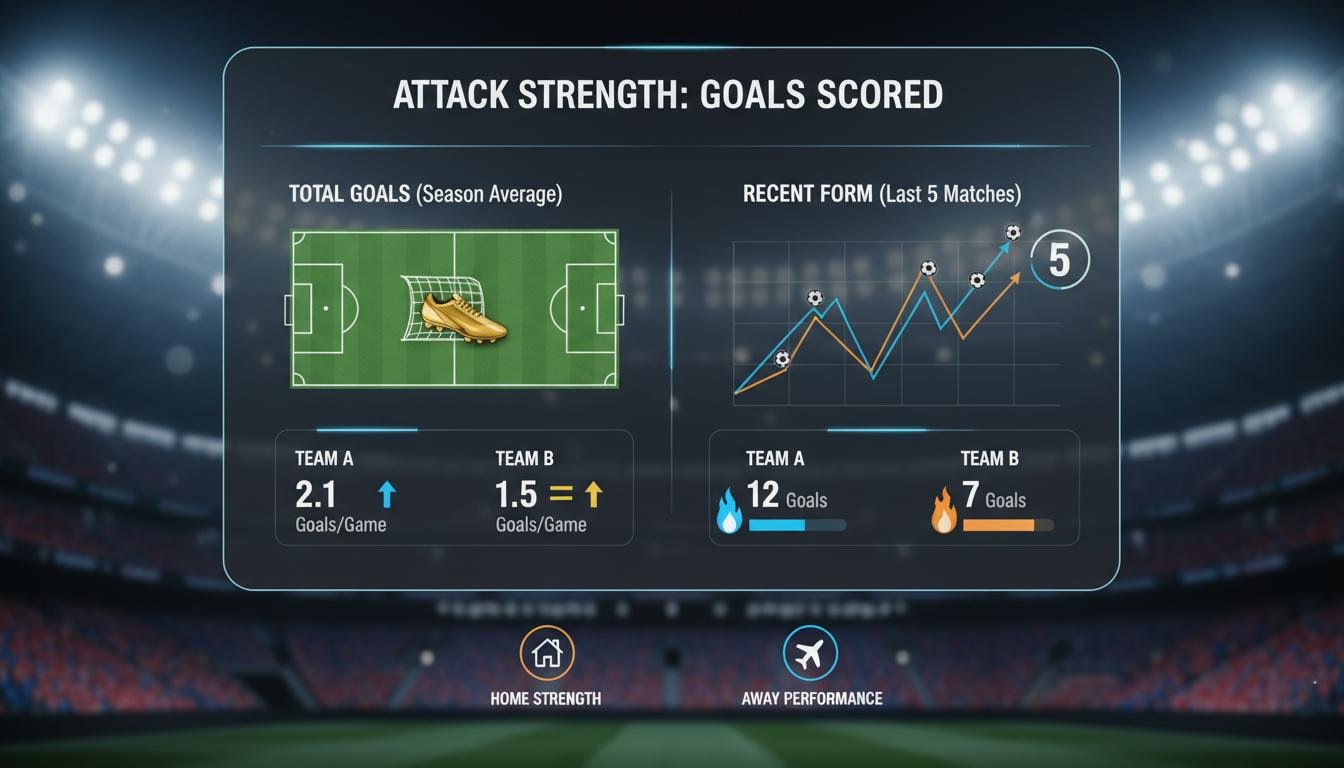
Start with split statistics: goals per first half, goals per second half, and expected goals (xG) separated by half. Underlying shot metrics — shots, shots on target, and high-quality chances — tell you whether goals are likely to follow the shots. xG per half is especially useful because it smooths randomness and reveals where a team actually creates danger.
Supplement xG with tempo and possession metrics. High possession in the attacking third before halftime suggests persistent early pressure that can yield first-half goals. By contrast, teams that only ramp up pace after the 60th minute will show a late-xG spike but little early threat. Also check set-piece frequency and corner rates for each half; set pieces are a reliable source of goals even when open-play chances are scarce.
Below is a compact reference table to interpret common indicators.
| Metric | What it shows | Betting implication |
|---|---|---|
| First-half xG > 0.4 | Consistent early goal creation | Higher probability of first-half goal |
| Second-half xG > first-half xG | Team tends to score later (fitness/pressing) | Look for second-half goals, especially if opponent tires |
| High set-piece xG | Threat independent of open play | Useful against low-block teams for both halves |
Contextual signals: tactics, personnel, and referees
Numbers need context. A manager who favors quick transitional attacks will commonly produce early chances because the team plays with pace from kickoff. A side that slowly builds through possession or deliberately conserves energy tends to create most danger in the second half. Watch recent lineup announcements: if a team rests their creative winger, early xG may collapse even if season averages remain high.
Referee and fixture context matter too. Some referees allow aggressive play and produce more free kicks and set pieces; others clamp down, slowing the game and reducing chaos that leads to early goals. Fixture congestion or travel can explain a sudden shift in a team’s half-by-half output: tired teams often concede late, while freshly rotated sides may start slowly.
Weather and pitch conditions are rarely decisive on their own but can shift how coaches approach a match. Rain and heavy wind favor direct play and set pieces, increasing the chance of early scrambles and goals. Consider match importance: cup knockout matches often open up late as teams chase a result, whereas league games with defensive caution can remain tight until late substitutions change the dynamic.
A step-by-step model you can apply before placing a bet
Follow a reproducible routine: gather data, weigh context, and decide where value lies. First, compile half-split stats for both teams over the last 8–12 matches: first-half xG, second-half xG, shots per half, and set-piece frequency. This window balances recent form with a meaningful sample size.
Second, compare the two teams head-to-head and consider styles. If both teams show above-average first-half xG, the probability of a first-half goal rises significantly. If one team is skewed to late scoring but faces an opponent that concedes early, the market may misprice the chance of goals in both halves.
Third, factor in lineup and game-state signals from press conferences and injury lists. An absent playmaker or a late-suspended defender can change the match profile. If a team announces a defensive overhaul, downgrade their early-scoring expectation even if their season numbers suggest otherwise.
Finally, calculate rough implied probability from the bookmaker’s odds and compare it to your model’s estimate. If your model gives a higher probability than the market after adjusting for uncertainty, you’ve found value. Keep stakes modest on markets with elevated variance and avoid chasing single extreme outcomes unless you have a clear edge.
Live betting and timing: how to react during the match
Watching the first 10–20 minutes gives you a live sample that can massively shift expected value. If a team dominates early territory, racks up shots, and forces corners, a failure to score can actually increase the value of a second-half goal market — the statistical law of averages suggests pending conversion. Conversely, a scrappy first half with few chances may lower your confidence in a second-half goal if both teams look conservative.
Substitutions are a major live signal. An attacking change around the 60–70 minute mark often correlates with a bump in second-half xG. Bookmakers adjust quickly, so monitor how odds move after substitutions and key events, then act if the market under-reacts. In-play discipline is essential: small, informed stakes reduce the impact of random variance while you refine intuition.
Risk management and real-world examples from my experience
In my own tracking of hundreds of wagers, the simplest protection was a rule: never commit more than 2–3% of bankroll to a goals-in-both-halves selection unless the model shows a clear edge. The market is volatile; single red cards, freak own goals, or a late tactical freeze can erase value instantly. Discipline keeps losing streaks manageable and leaves capital for long-term edges.
One match that taught me patience was a midtable cup tie where both sides averaged high second-half xG but low first-half output. Early indicators — a patched defensive lineup and conservative early play — suggested the market overweighted late goals. I wagered minimally and watched a predictable late opening; the modest stake saved me from overexposure and still returned value when the game eventually produced goals in both halves.
Record-keeping matters. Log the statistics you used, the lineup signals, the odds, and the eventual result. Over time you’ll see which metrics predict half-by-half outcomes most reliably in the leagues you follow, and you can prune the noise from your model.
Practical checklist before you place a bet
Use this quick checklist as a final sanity check before committing money. It keeps decisions evidence-based and reduces emotional bets when high-profile names are involved.
- Confirm half-split xG and shot metrics for both teams over the last 8–12 matches.
- Verify lineups for missing creators or defenders and any tactical announcements.
- Assess referee tendencies and weather that could alter play style.
- Compare your probability estimate to implied odds for value; only bet when you have a quantified edge.
- Set a fixed stake based on bankroll rules and record the bet details for review.
Sources and further reading
- FBref — team and player statistics, including xG and half splits
- StatsBomb — football analytics articles and datasets
- Understat — expected goals and shot data
- Opta — professional sports data and insights
- Premier League — official match and referee statistics
Assessing attack strength by half is a matter of combining stable metrics like xG splits with situational judgment about tactics, personnel, and match pressure. If you build a repeatable routine, keep records, and manage risk, the goals-in-both-halves market can become a disciplined part of your portfolio rather than a roll of the dice.