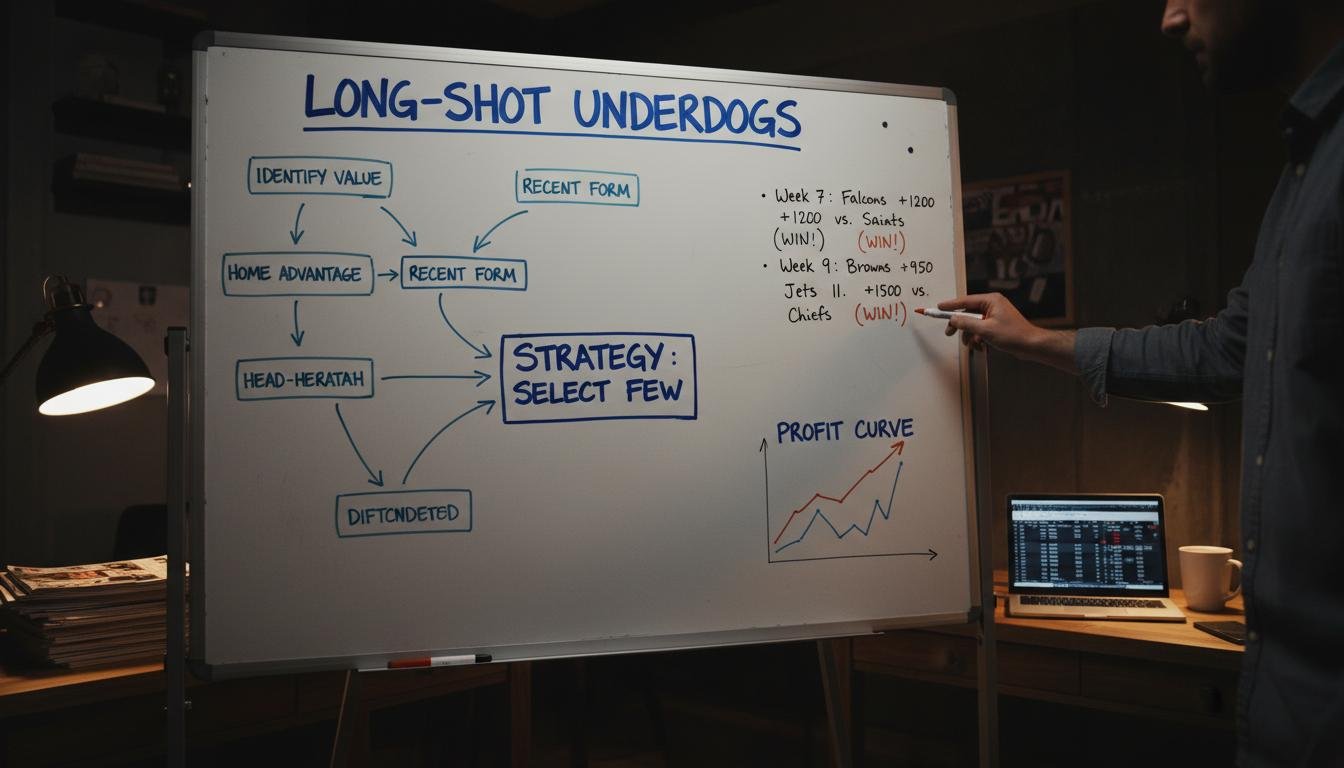
There’s a special kind of thrill in backing the long-shot underdog — the roar when the impossible briefly looks possible, the arithmetic of turning a small stake into a big payoff, and the hard lesson that surprise upsets are rarer than highlight reels suggest.
Why backing long shots can make sense
Most bettors assume favorites are “safer” because they win more often, but from an investment perspective the favorite is rarely where value hides. Bookmakers build margins into favorites’ prices; that margin can compress value even when outcomes feel more certain.
Underdogs pay better odds, and if your probability estimate for an upset is even slightly higher than the market’s, repeated, disciplined bets can exploit that edge. The trick is turning a series of small, positive-expected-value opportunities into long-term gains rather than chasing a single lucky ticket.
Understanding probability, value, and odds
Odds are a market’s shorthand for probability plus margin. Converting decimal odds to implied probability and comparing that to your own model is the only objective way to hunt value.
Expected value (EV) is the key concept: bet size times (probability of win × payout minus probability of loss × stake). A +EV underdog bet may still lose often; that’s why psychological readiness and bankroll rules matter.
Estimating real upset probability
Accurate probability begins with good inputs: form, away/home splits, injuries, head-to-head trends, and matchup-specific stats like expected goals (xG). Combining quantitative models with on-the-ground context reduces blind spots that pure intuition creates.
I once tracked English Championship underdogs for a month, blending xG trends with a simple travel-fatigue adjustment; small edges emerged when teams flew midweek and faced opponents coming off cup runs. Those edges were subtle, but over many bets they separated guesses from repeatable advantage.
Bankroll management and the Kelly criterion
Successful long-shot strategies aren’t about big bets — they’re about the right bets at the right size. Overbetting on long shots destroys bankrolls quickly because variance is huge.
The Kelly criterion offers a mathematically grounded staking rule: it recommends a fraction of your bankroll proportional to your edge divided by the odds’ payout. In practice, many bettors use fractional Kelly to limit volatility and psychological strain.
Practical staking: fractional Kelly and flat-bets
Fractional Kelly (for example, one quarter or one eighth Kelly) smooths swings and keeps you in the game through inevitable losing streaks. For many, a flat-betting approach — staking a fixed percentage of bankroll on each underdog pick — is simpler and surprisingly robust.
| Perceived edge | Odds (decimal) | Full Kelly stake (%) | Quarter Kelly stake on $10,000 |
|---|---|---|---|
| 10% true probability vs 7% market | 14.0 | ~2.1% | $52.50 |
| 15% true vs 10% market | 9.0 | ~3.3% | $82.50 |
This table is illustrative: inputs depend on your model and the book’s vig. Use conservative fractions to survive variance and preserve optionality.
Finding edges: where bookmakers misprice underdogs
Markets are efficient where information is abundant: top competitions, televised matches, and markets with heavy sharp action. Edges tend to appear in less-trafficked places — lower leagues, international breaks, niche props, or late line moves caused by public overreaction.
Line shopping and multiple accounts are practical necessities. A seemingly small difference in odds can flip a negative EV bet into a positive one, so comparing prices across books and exchanges is low-effort, high-return work.
Situational factors bookmakers undervalue
Common blind spots include last-minute team news (benching a star, rotation), psychological factors (relegation battles, derby pressure), travel logistics, and weather that alters playing style. Betting markets sometimes underreact to these until late, creating opportunities for quick, informed wagers.
Constructing a portfolio of long-shot bets
Think of underdog betting like building an investment portfolio. Diversify across leagues, bet types (moneyline, handicaps, props), and time horizons. Avoid concentration in a single team or market because variance can wipe out short-term gains.
Set clear rules for entry and exit: only bet where your model suggests a specific minimum edge, cap exposure per event, and never increase stake after losses chasing wins. Discipline trumps intuition when the odds sting.
Tracking, discipline, and common pitfalls
Recordkeeping is non-negotiable. Log odds, stakes, your estimated probability, and the reason for each bet. Periodically backtest and prune strategies that don’t show sustainable edge. Many bettors fail not from bad ideas but from failing to learn from data.
Beware of confirmation bias: a glorious upset can make an overbet feel justified even when the long-term numbers say otherwise. Also watch for survivorship bias when reading other bettors’ hot streaks — we rarely see the hundreds of small losses behind a single lucky headline win.
Responsible gambling and staying in the game
Long-shot strategies demand emotional resilience. Set loss limits, establish cooling-off rules, and never treat gambling as income. If betting shifts from entertainment with discipline to a compulsive pursuit, seek help from professionals and support organizations.
Sources and further reading
These resources informed the approaches and concepts discussed above. Read them to dive deeper into probability, market behavior, and responsible betting.