Betting on a goal after halftime is one of those markets that feels both simple and subtle: either a ball crosses the line in the final 45 minutes or it doesn’t. That apparent simplicity masks a range of signals you can read to tilt the odds in your favor. This article walks through how the market works, what data really matters, and practical tactics you can use before kick-off and in-play to make smarter decisions.
What the market is selling and why prices move
The “goal in the second half” market includes a few variants — a generic “any goal in second half,” team-specific second-half scorers, and more precise bets like “over/under goals in the second half.” Bookmakers price these based on expected second-half scoring rates, pre-match probabilities, and live events such as injuries or red cards.
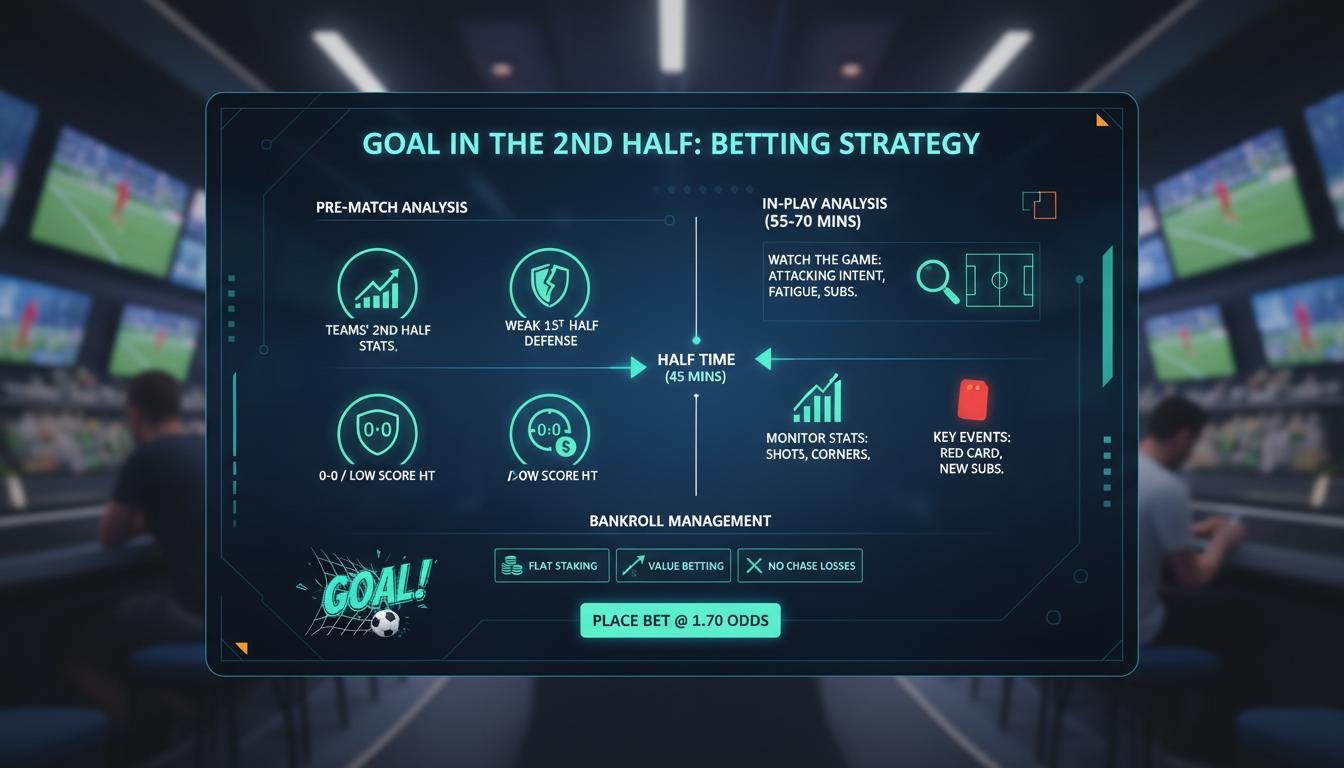
Odds shift quickly when the first half ends goalless or when one team dominates but fails to score. A 0–0 half often inflates the implied chance of a second-half goal because bettors anticipate a correction: pressure should eventually pay off. The smart approach is to separate emotional reactions from the underlying match signals that actually predict a late goal.
Data points that predict second-half goals
Goals are not uniformly distributed across matches. Expected goals (xG), shots in the box, and shot quality are better predictors than raw possession. Teams consistently generating high-quality chances without converting in the first half are statistically more likely to score after halftime, and vice versa for teams creating little.
Other important indicators include tactical tendencies (do teams press harder after halftime?), substitution patterns, and historical second-half scoring rates. Analyses from data providers show that team’s fitness levels, squad depth, and manager behavior (frequency of attacking substitutions) materially influence late goals.
Key predictive checklist
Use this short checklist before placing a bet: shots on target, xG first half, number of corners, attacking intent (third‑party metrics like progressive passes), and lineup news. If three or more indicators point toward attacking dominance without a finish, that often signals value in backing a second-half goal.
- High first-half xG and shots in the box → increased second-half scoring probability
- Multiple corners or sustained pressure → higher chance of later goals
- Defensive injuries or red cards at halftime → spike in scoring odds
- Weather and pitch conditions — bad conditions can suppress second-half chances
Pre-match strategy: where to find value
Pre-match, look for mismatches in style rather than just rating. A disciplined low-block team against a side that struggles to break compact defenses might still yield a second-half goal if that side tends to push late. Conversely, games between two pragmatic, defensive teams often produce low second-half scoring and should be avoided for this market.
Head-to-head trends and manager habits matter. Some managers are notorious for late substitutions that change a game’s trajectory. Track which teams typically score or concede more after the break and weight that history alongside current form.
Live-betting tactics: making the most of in-play signals
In-play markets are where second-half goal betting really shines. Waiting until halftime lets you absorb 45 minutes of evidence: were the chances high-quality? Did either keeper make a string of saves? Is one side visibly tiring? These are the moments when markets under- or over-react, and where you can find strong value.
Watch for three practical live signals: sustained territorial pressure entering the second half, an attacking substitution at or just after halftime, and an opposing defensive breakdown such as a yellow card buildup or a player hobbling. When two of these appear together, the odds often move faster than the underlying probability, creating an opportunity.
Example of a live approach
In my own live-betting experience, I once followed a lower-league match where the away side had five shots in the first half and an xG of 0.9 but trailed 0–0. The home team defended narrowly and made a conservative halftime substitution. Odds for a second-half goal moved from 1.9 to 1.5 within eight minutes as the away team resumed aggressive pressing — a clear signal to stake a portion of my bank on a goal after the break.
That wager wasn’t a blind guess; it was backed by the combination of xG, shot volume, and the opponent’s lack of fresh legs. The goal arrived after an attacking substitution created an overload on the wing.
Bankroll rules and staking for second-half bets
Second-half bets are attractive because they often allow small, timely stakes with high information. Still, disciplined bankroll management is essential. Treat these as specialty bets: keep stakes modest (a fixed small percentage of your bankroll per tip) and consider fractional Kelly sizing if you have a robust edge estimate.
Avoid impulse doubling after a loss. Because live situations trigger emotional reactions, a pre-set staking plan reduces poor decisions. Use the same bet-sizing rules you’d apply to any market — clear stakes, defined maximum exposure per match, and a monthly loss cap to protect variance.
Common mistakes that cost money
Chasing a late goal because of “momentum” is a common trap. Momentum is often just confirmation bias unless backed by measurable indicators like sustained xG pressure. Another error is ignoring bench strength; teams with lazy-looking subs can flip a matchup quickly, while teams with thin benches often fade.
Also beware market liquidity. In niche matches or small leagues the live odds can be wide and contain large bookmaker margins. If the margin is too fat, the long-term expectation flips against you regardless of your match read.
Tools, data sources, and experts to follow
Quality second-half reads require access to reliable data: live xG, shot maps, and expected goals timeline. The Analyst and WhoScored provide robust post-match and real-time metrics. For broader statistical context and modeling ideas, FiveThirtyEight’s soccer coverage is instructive. Official bodies like UEFA and FIFA publish research about match patterns that help frame macro trends.
Combine those resources with live lineups from trusted trackers (e.g., the team’s official feed or reputable match trackers) and a stopwatch for substitution windows. The better the feed, the faster you can act on true value signals.
Practical small table: indicators and their influence
| Indicator | How it influences second-half goals |
|---|---|
| First-half xG ≥ 0.8 | Strong signal — existing chance quality suggests a goal is likely later |
| Multiple corners/blocked shots | Shows territorial pressure — increases second-half probability |
| Halftime attacking substitution | Manager intent to push often raises scoring odds |
| Red card or key injury | Can drastically alter probability depending on which team is affected |
Betting on a second-half goal rewards patience, structure, and attention to context. If you start by building a short checklist, use live xG and shot metrics, and protect your bank with disciplined stakes, you’ll find the market clearer and less emotional. Treat information as the commodity you trade, and the odds will often follow.
Sources and experts referenced: