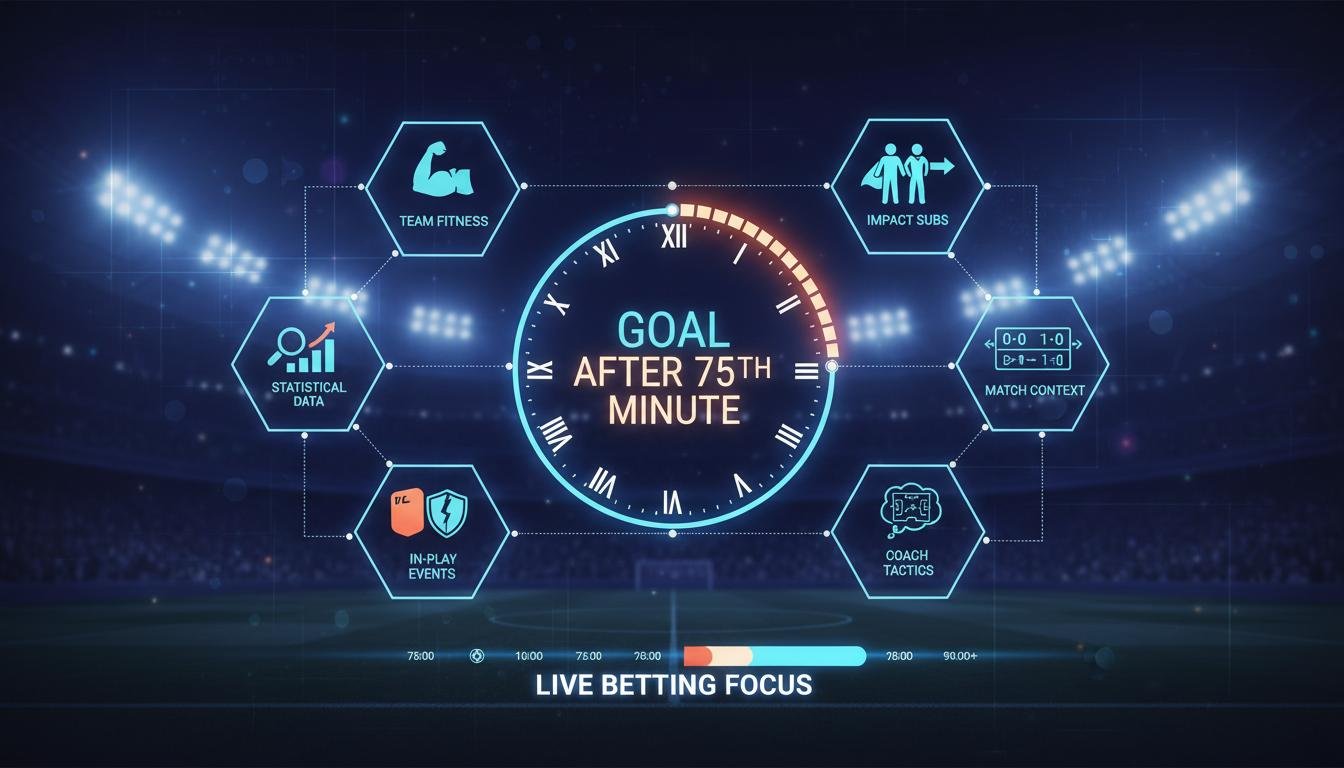
Placing a wager on a goal after the 75th minute is a focused, high-drama approach to in-play football betting. It strips the game down to a compact window where fatigue, tactical changes, and desperation collide—and where smart observation and preparation can tilt the odds in your favor. This article walks through how to prepare before kickoff, what to watch during the match, and how to size bets so a few late goals don’t wreck your bankroll.
Why the last 15 minutes matter
Late goals are not random fireworks; they emerge from predictable game dynamics. Teams leading by a single goal often sit deeper, inviting pressure, while trailing sides push bodies forward—more crosses, more set pieces, and more chaotic sequences inside the box.
Substitutions and player fatigue amplify these tendencies. Fresh forwards and tired center-backs create mismatches; a single moment of inattention or a mistimed challenge can produce a late equalizer or winner. Understanding how those forces interact is the essence of this betting angle.
Pre-match preparation: what to research
Before you place a pre-match or early in-play stake, gather a small dossier: each team’s propensity to concede or score late, their substitution patterns, and the manager’s in-game tendencies. Look for teams that frequently score or concede after the 75th minute in recent fixtures—patterns repeat.
Also weigh situational context: is the match a cup tie with extra-time possible, a relegation battle, or a midtable fixture with little at stake? Games with high importance produce more late drama; low-stakes matches often see managers prioritizing player fitness over chasing goals.
Key in-play signals to watch closely
When live, track a handful of metrics that reliably indicate increasing late-goal probability: xG and xG chain trends, shots on target in the last 15–20 minutes, number of corners and dangerous possession inside the final third. These are more informative than raw possession percentage alone.
Also monitor substitutions, especially attacking changes and late fullback switches. Red cards and injury stoppages can swing momentum dramatically. Finally, watch body language: hoarse managers, frantic defending, or repeated midfield turnovers are practical indicators of mounting pressure.
Markets and bet types that fit this strategy
Bookmakers typically offer both pre-match and in-play bets for a goal after the 75th minute; some label it as “goal after 75:00” or “goal 76–90+.” You’ll also find related markets—next goal, time-of-next-goal bands, and Asian-style late goal lines—that let you shape risk more precisely.
For a conservative approach, consider hedged lines such as “goal in 76–90+” combined with a small stake on “no goal” and cashing out if the odds move favorably. For aggressive plays, a single straight bet in-play when indicators align can yield good value because live odds often lag real-time pressure.
Checklist table: late-goal indicators
| Indicator | Why it matters |
|---|---|
| Shots on target (last 20 minutes) | Direct evidence of sustained attacking pressure |
| Corners accumulated | Set-piece volume often leads to chaotic late chances |
| Substitution pattern | Fresh attackers vs tired defenders increases scoring chance |
| Red card / man advantage | Shifts balance and opens space for late goals |
Staking and bankroll rules
Late-goal bets are high-variance. Treat them as a small, defined portion of your bankroll—typically 1–3% per selection for regular bettors. This keeps losing streaks manageable while allowing occasional bigger stakes when the edge is clear.
If you use a mathematical staking model, the Kelly criterion is worth understanding because it scales stake size to estimated edge. In practice, many bettors use a fractional Kelly (for example, one-quarter Kelly) to reduce volatility. Conservative fixed-percent staking is simpler and effective for this compact market.
Practical playbook: step-by-step
Pre-match: identify matches where one or both teams regularly concede or score late and where the managers historically make attacking substitutions. Bookmark the fixtures and check weather and referee tendencies—some referees add less stoppage time, which matters for 90+ minute expectations.
In-play: wait until the final third of the match to act. If you see two or more indicators—sustained xG advantage, an attacking substitution, and a steady stream of corners—consider entering. Use live odds movement to your advantage: odds often shorten only after a big chance is created, so be ready to act early.
- Monitor metrics (xG, shots, corners)
- Watch substitution and card events
- Place conservative pre-emptive stakes or an in-play stake with tight bankroll limits
- Consider hedging or cashing out if the in-play value erodes
Common pitfalls and how to avoid them
Chasing losses and overreacting to a single match’s late drama are the two biggest mistakes. One dramatic equalizer doesn’t change a team’s underlying trend; ignore one-off noise and stick to your criteria. Discipline beats instinct in clock-dependent betting.
Another trap is mistaking volume for quality—many late crosses do not translate into real scoring chances. Focus on meaningful metrics like shots on target and quality of chances (xG), not mere possession or crosses completed into the box.
Psychology and live decision-making
Live betting amplifies emotions: adrenaline makes stakes feel smaller and losses sting more. Set pre-defined rules for when to enter and when to walk away, and use small, consistent stake sizes to keep decisions unemotional. If you cannot follow rules under pressure, reduce or avoid live late-goal plays.
Use interruption points like the 75th-minute mark as decision gates—either enter with a preset stake or skip. That mechanical discipline preserves capital and creates a repeatable approach, which is essential for long-term success.
Real-life example from my experience
A few seasons ago I tracked a midtable team that habitually introduced a target forward around the 70th minute and generated many corners and shots but struggled to convert early. In multiple matches, the data showed rising xG from the 75th minute onward, and one small, disciplined in-play stake across several fixtures produced several modest winners without wrecking the bankroll.
The plan worked because it was repeatable: I only bet when at least two indicators aligned and always sized stakes at no more than 2% of my running bankroll. The approach didn’t win every game, but it converted an acute edge into a consistent income stream over a season.
Final thoughts and practical reminders
Betting on a goal after the 75th minute is a focused strategy that rewards preparation, disciplined staking, and attention to live indicators. Treat the market like a short-term trade: research, set entry rules, and manage risk tightly.
Keep a journal of every stake—why you entered, what indicators were present, and the outcome. Over time you’ll learn which leagues, teams, and situations reliably produce late goals and which are merely noise. That feedback loop is how a small edge becomes a repeatable advantage.
Sources and further reading
- StatsBomb — timing and xG analyses: https://statsbomb.com
- Opta / StatsPerform insights on goal timing: https://www.optasports.com
- FiveThirtyEight soccer models and timing articles: https://fivethirtyeight.com
- UEFA technical reports and match analysis: https://www.uefa.com/insideuefa/studies/
- Explanation of the Kelly criterion (staking theory): https://www.investopedia.com/terms/k/kellycriterion.asp