Friendly internationals often feel like exhibitions — coaches experiment, clubs recall players, and television markets churn out odds that don’t always reflect on-field reality. For anyone who treats betting as both a hobby and a craft, those mismatches between intention and expectation create opportunity. This article walks through practical, evidence-based approaches to betting on international friendlies, emphasizing discipline, research, and knowing when to sit out.
How friendlies differ from competitive internationals
Friendly matches are rarely about full-strength competition. Coaches use them to test formations, cap young players, or preserve fitness; the result is that starting lineups and tactical intent can vary widely from what betting markets assume. That variability is the core factor that makes friendlies distinct and, when handled carefully, potentially profitable for the disciplined bettor.
Another key difference is the substitution culture. Unlike tournament or qualifier matches, teams may make numerous changes at halftime to assess personnel, which affects match flow and goal probabilities. The substitution pattern means that pre-match expectations can unravel quickly, so timing your bets and watching confirmed lineups is crucial.
Logistics also matter: travel schedules, altitude, and domestic league calendars influence player availability and motivation. A mid-season friendly during a busy club schedule will lead to more rested—or conversely, more fatigued—players depending on club cooperation and national team priorities. These behind-the-scenes details are where you find predictive edge if you research them before staking money.
Where market inefficiencies tend to appear
Bookmakers set lines based on models and market exposure, but friendlies invite mismatch between model inputs and reality. Public money often follows reputation rather than roster truth: large-name nations attract bets irrespective of who actually plays. That bias can lead to inflated favorites and value on outsiders who field stronger squads or have a clearer objective.
Odds often move slowly after lineup announcements compared to competitive fixtures. If a heavy favorite names a raft of replacements, the market might not immediately retract the price to reflect the weakened side. Traders who monitor official lineups and injury reports can sometimes capture value in the period between announcement and kickoff.
Live markets are another source of inefficiency. Early substitutions and experimental tactics make in-play lines fragmented and volatile. For bettors who prefer watching the first 10–20 minutes, that volatility can be an invitation to place small, well-timed bets based on the actual tempo and shape of the game rather than pre-match projections.
Key variables to check before staking
Below is a short table of high-impact factors to verify before placing bets on friendlies. Treat these as a checklist you can scan in five minutes to avoid obvious traps and to spot opportunities quickly.
| Variable | Why it matters | How to assess |
|---|---|---|
| Confirmed lineup | Reveals true strength and tactical intent | Check national federation and trusted journalists 90–60 minutes before kickoff |
| Substitution policy | Affects game continuity and goalscoring odds | Look for coach comments and past friendly substitution patterns |
| Motivation level | Determines intensity and risk-taking | Consider upcoming tournaments, qualification needs, or contract seasons |
| Travel and scheduling | Impacts fatigue and availability | Check club fixtures and travel distance/time zones |
Practical betting strategies for friendlies
First rule: accept that friendlies are high-variance events and scale stakes accordingly. Use smaller stake sizes than you would for competitive fixtures and avoid making the outright result your primary focus unless you have definitive lineup intel. Smaller stakes preserve bankroll while you exploit edge on marginal markets.
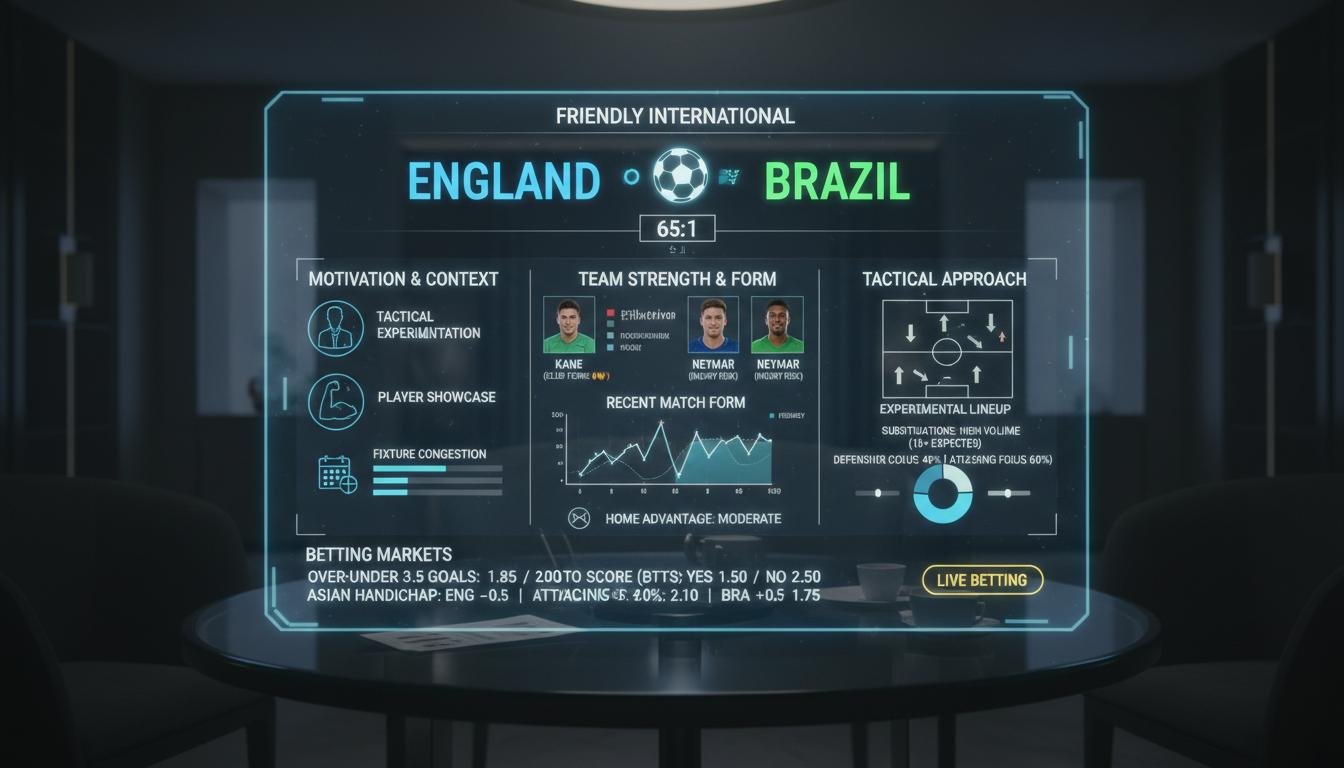
Prop markets often offer better value than match outcomes. Bets like “both teams to score,” over/under on goals, or player-related props (first substitution, any player to score) are less sensitive to single absences. Because friendlies can feature more substitutions and experimental defense, goal-related props can be profitable when you identify a mismatch between the two teams’ intentions.
Asian handicaps and draw-no-bet options also suit friendlies. Handicaps can neutralize reputation bias by pricing in the expected weakened lineup of a favorite. Draw-no-bet is useful when a strong team has rotated heavily — it reduces downside while retaining upside if the makeshift side still demonstrates control.
Lineup-driven tactics
Always delay larger bets until official lineups are posted. Federations and credible local journalists often publish starters an hour before kickoff; that window is when markets react and where you can find mispricing. If an underdog retains their best XI while a favorite rests stars, odds should adjust, and that’s when to act.
Consider focusing on teams that clearly state their objectives. If a federation announces a roster aimed at building chemistry for a tournament, their January friendly is not casual — it’s part of a larger plan. Betting on a team with consistent selection and purpose tends to be less risky than backing a side using the friendly purely for experimentation.
Be mindful of players’ club commitments. When key players are missing due to club refusal or injury, the tactical approach shifts. A tactical switch from a pressing 4-3-3 to a conservative 4-5-1 because of personnel changes has predictable consequences on goal markets and corners, and savvy bettors adjust accordingly.
In-play strategies and timing
Watching the match live is especially powerful in friendlies. Early substitution patterns — heavy rotation at 45 minutes, for example — will tell you whether the coach treats the game as a one-off or a long trial. If pace drops and shape dissolves, favor goal markets; if intensity remains, back the side demonstrating consistent pressing and structure.
Halftime is often the best moment to re-evaluate. Coaches typically give clear signals in their substitutions and tactical tweaks. Betting into the second half with insight gleaned from first-half patterns lets you avoid relying on pre-game assumptions that have been invalidated by in-match behavior.
Use live-data providers for metrics like expected goals (xG), shots on target, and progressive passes when available. Those numbers are more informative than scoreline alone and help you predict the likely second-half trajectory. But remember: friendlies can produce wild statistical swings, so treat any live edge conservatively and size stakes accordingly.
Bankroll discipline and learning from every trade
Adopt a strict staking plan. Flat-unit or percentage-of-bankroll models work well in friendly markets because the edge is usually small and uncertain. Keep each bet to a modest fraction of your bankroll and avoid escalating after losses; emotional reactions are costly when outcomes are noisy.
Record keeping is some of the best research you can do. Note why you placed each bet, the information used, and post-match outcomes. Over time you’ll identify which signals (lineups, substitution patterns, coach interviews) actually predict results and which are noise.
Don’t confuse entertainment with investment. It’s fine to watch friendlies for fun, but only bet when your process indicates an edge. Over time, the small, disciplined gains from reliable signals will outpace the occasional thrill bet that looks attractive but has no systematic rationale.
Ethical and safety considerations
Be aware of match-fixing risk, which unfortunately exists more in low-profile friendlies between lesser-known federations. Avoid markets that show suspicious movement and steer clear of inside information from non-official sources. Betting based on public, verifiable facts preserves your legal and ethical standing.
Always follow the law and your jurisdiction’s regulations. Use licensed sportsbooks, and consider exchanges for better odds transparency. If you suspect irregularities in a match, report them to the sportsbook and the relevant betting integrity bodies rather than acting on the rumor.
Final tips and quick checklist
Bet smaller than you would in competitive fixtures, wait for confirmed lineups, and prefer props and handicaps over straight match-winner bets. Watch the first half before committing significant funds in-play, and treat every friendly as a research opportunity to refine your model and intuition.
Short checklist:
- Wait for confirmed lineups 60–90 minutes before kickoff.
- Compare team objectives and recent selection trends.
- Prioritize props, Asian handicaps, and draw-no-bet options.
- Watch live for substitution and tempo clues before increasing stake size.
- Keep disciplined staking and log every bet for future learning.
Approach friendlies with humility. They are noisy by nature, which punishes overconfidence but rewards careful preparation. If you treat each game as an information event rather than just a chance to win big, you’ll make fewer mistakes and capitalize on the sporadic edges those matches provide.
Sources and expert references
- FIFA — match calendars and national team announcements: https://www.fifa.com
- UEFA — national team competition and regulations: https://www.uefa.com
- Pinnacle sportsbook — betting market research and articles: https://www.pinnacle.com
- FiveThirtyEight — international soccer predictions and analytics: https://fivethirtyeight.com
- Transfermarkt — player availability, caps, and club commitments: https://www.transfermarkt.com
- OddsPortal — odds history and market comparison: https://www.oddsportal.com