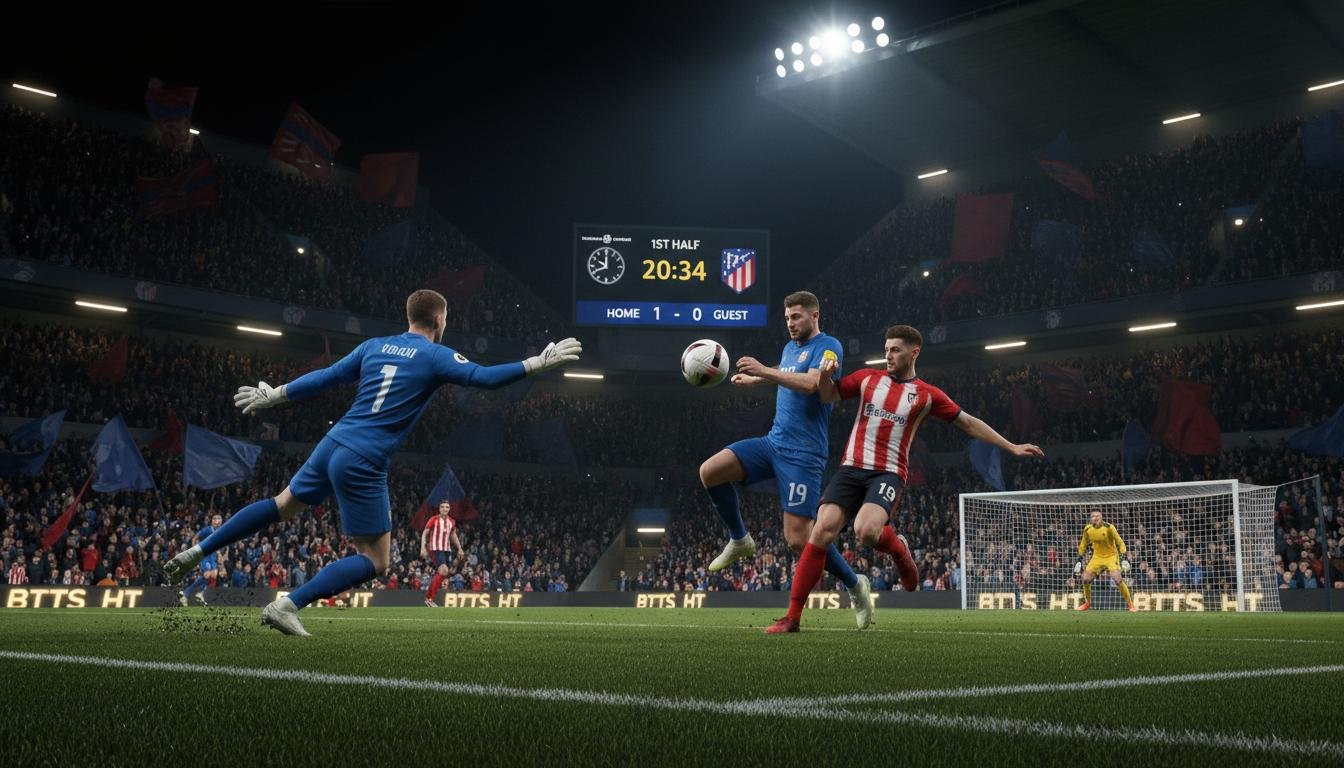
Halftime markets move fast and they reward attention: a goal early in the first half, a tactical switch, or a red card can all reshape the odds within minutes. This article walks through a practical approach to trading the “both teams to score” outcome specifically for halftime — not a promise of easy wins, but a methodical framework that mixes pre-match research, live cues, and disciplined staking.
Why halftime BTTS is its own animal
Full-time both teams to score (BTTS) and halftime BTTS are related but behave differently because of time constraint. With only 45 minutes to decide the market, variance is higher and small changes in momentum have outsized effects on probability.
Bookmakers price halftime BTTS based on expected first-half scoring rates and live information such as injuries or sending-offs. That means pre-match models are useful, but live observation can create opportunities when the market hasn’t yet fully adjusted.
Key indicators to watch live
Successful halftime BTTS plays come from watching the right signals. Focus on first-half expected goals (xG) flow, dangerous chances, set piece volume, and how each team is shaping up defensively rather than raw possession percentages.
Below is a compact checklist you can use in-play. These items tend to show up early and predict whether both teams are likely to have scored by halftime.
| Indicator | Why it matters |
|---|---|
| High cumulative xG (both sides) | Shows quality chances are being created on both ends, increasing BTTS likelihood. |
| Repeated set pieces in attacking zones | Set plays create scoring odds quickly in the first half when defenses are settling. |
| Attacking fullbacks / open wings | Suggests defensive gaps that can lead to counter opportunities for the opponent. |
| Recent substitutions or visible fatigue | Late early mistakes rise with tired defenders or tactical changes. |
Pre-match homework that pays off
Before kickoff, build a shortlist of matches where first-half goals are plausible. Look for teams that show a split between first- and second-half scoring — some teams are consistently stronger early. Historical first-half BTTS rates and average first-half goals per match are practical metrics.
Also check squad news closely. A defensive midfielder suspended or a starter recovering from injury can change early-match balance. I set alerts for lineups and late team news because early substitutions and unexpected absences are common triggers for halftime opportunities.
Live tactics: when to back halftime BTTS
There are a few live scenarios where the value becomes clear. One is slow starts by both teams but with clear chances created that have been missed — a high-xG game with no goals yet. Another is a match where one side is open and conceding dangerous counters; the opponent may score quickly but also leave space at the back.
Use a simple decision checklist in-play: Are there quality chances for both teams? Has the scoreboard masked true attacking play? Has a key defensive player been subbed or booked? If the answer is yes to at least two items, the halftime BTTS market may be underpricing the chance of a goal from each side within 45 minutes.
Scenarios that often produce value
- High neutral xG with neither team clinical yet: expect goals soon from both ends.
- Teams with attacking philosophies facing each other early in the season when defenses are porous.
- Weather or pitch conditions that favor direct play, increasing set-piece and counter chances.
Staking and bankroll rules for volatile markets
Halftime BTTS is higher variance than many markets. Your staking plan should reflect that: use smaller units than you would for full-time markets and never chase losses within a match. A sensible approach is to risk 0.5–1% of your bankroll on a typical halftime BTTS selection, adjusting down when odds drop below expected value.
Keep a live tracking sheet. Record the market price when you place a bet, your reasoning, and the outcome. Over time you’ll see which cues are reliable and which were one-off flukes — that discipline separates repeatable edges from noise.
Tools and data to use
Access to live expected goals (xG) and shot maps is a game-changer for halftime trades. Providers such as FBref and StatsBomb publish underlying metrics that help you judge chance quality rather than count every shot as equal.
Also use live feeds for lineup changes, bookings, and injuries. The market reacts quickly, so a lag in your information is costly. Combining a live stats feed with a mobile bookmaker app minimizes the time between your call and execution.
Common mistakes to avoid
A frequent error is confusing possession with real attacking threat. A team can dominate possession without creating meaningful chances, which isn’t helpful for BTTS. I once backed a halftime BTTS based only on possession data and learned the hard way — the match had low-quality buildup and ended 0-0 at the break.
Another mistake is overreacting to a single event, like a red card, without reassessing the full tactical picture. A sending-off can reduce one side’s attacking threat while giving the other more space — that often lowers the chance the team with the red will score, making BTTS less likely.
Putting it together: a sample step-by-step strategy
Step 1: Pre-match shortlist two to four games where first-half goal probability is elevated because of team styles and first-half scoring history. Step 2: Monitor lineups and last-minute news; eliminate matches if a key attacking player is absent.
Step 3: At kickoff, watch the first 15–25 minutes. If both teams generate high-quality chances (look at xG or shot location), consider placing a small halftime BTTS bet when odds still reflect the uncertainty. Step 4: If a clear disqualifying event occurs — for example, one side becomes ultra-defensive or an early red card undermines their scoring ability — avoid betting or cancel if possible.
Responsible approach and limits
Always treat halftime BTTS as speculative. The short time window inflates variance and no strategy will eliminate variance. Set strict stop-loss rules for chasing losing runs and avoid increasing stakes mid-game out of emotion.
If you’re using live bots or automation, build conservative triggers and test them on historical data. Automation can execute quickly but it will also multiply mistakes when your model misunderstands a tactical nuance.
Practical takeaways from experience
From my own live trading, the most consistent winners came from small, disciplined bets placed on matches where both teams showed intent in the first 20 minutes. I made my best margin by refusing to bet every game and by logging every play to refine my trigger list.
Sometimes you’ll see a market drift that looks tempting; patience is key. A gradual pattern of quality chances is a better predictor than a single scramble or a fluke shot that brushes the post.
Sources and experts
For statistical grounding and live metrics I relied on public datasets and analyses from these authorities and resources:
- FBref — match and player statistics, including xG and first-half breakdowns: https://fbref.com/en/
- StatsBomb — methodology and football analytics articles: https://statsbomb.com/
- FiveThirtyEight Soccer — predictive models and team ratings: https://fivethirtyeight.com/sports/soccer/
- UEFA — official competition statistics and first-class match reports: https://www.uefa.com/
- Dixon, M.J., & Coles, S.G. — foundational academic work on modeling football scores (see statistical journals for full text).
These links and readings will help you test ideas and backtest triggers before staking real money. Above all, combine data with careful in-play observation — that blend is what makes halftime BTTS a trade rather than a guess.