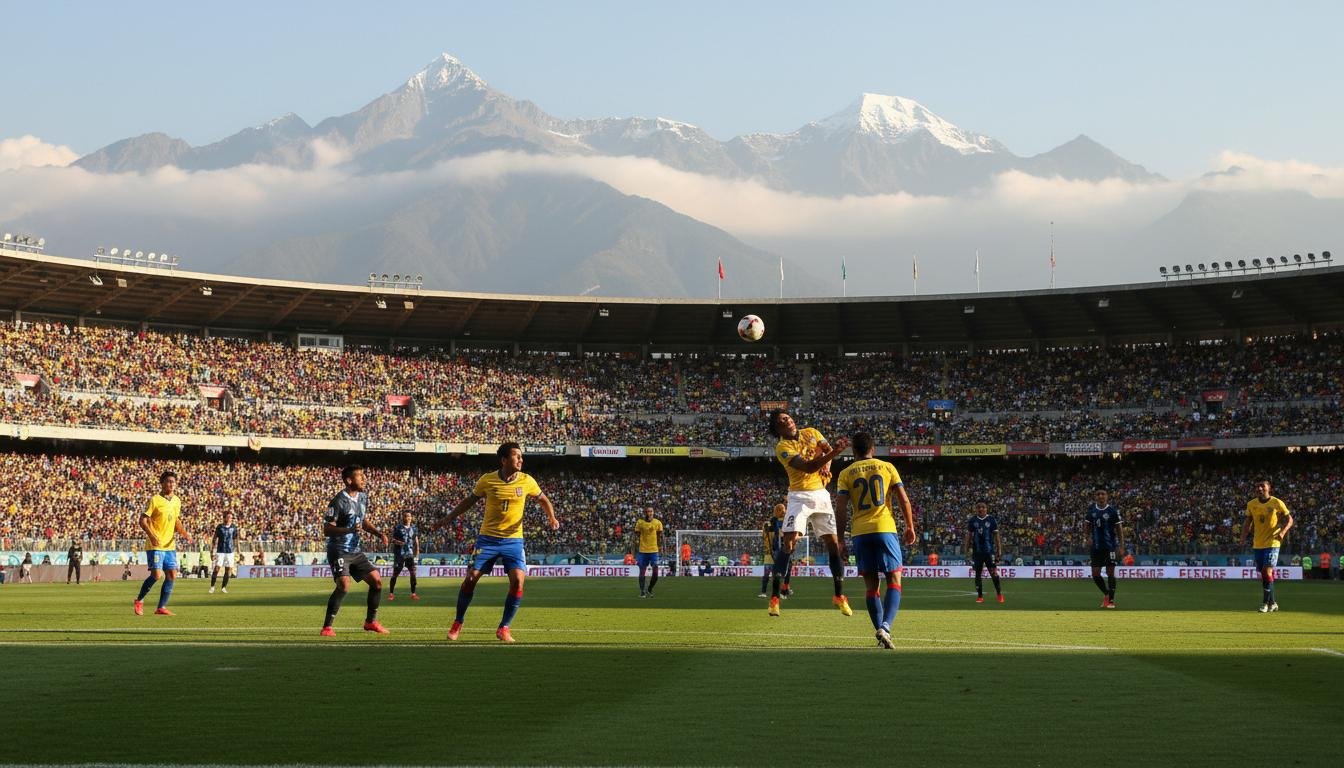
Ecuador occupies an unusual place in world football: a small nation whose geography gives its clubs and national team an environmental edge. This article unpacks that advantage with an analytics eye, combining physiology, statistics, tactical adjustments, and practical recommendations for visitors. I aim to translate the science and data approaches into clear, actionable insights while situating the story in the real-world context of Ecuadorian stadia and competitions.
Why altitude changes the game
Altitude affects sport through two broad channels: the human body and the ball. Reduced atmospheric pressure at elevation lowers the oxygen available for aerobic metabolism, so players working above roughly 1,500–2,000 meters begin to experience quantifiable changes in stamina, recovery between sprints, and perceived exertion.
Ball physics change too. Thinner air reduces drag, so long passes, shots, and crosses travel farther and feel faster. That alters goalkeeper judgment and the timing of defensive lines, especially for squads unused to the trajectories common at higher elevations.
Those two channels—physiology and aerodynamics—interact with match planning. Coaches who understand the interplay can tilt tactical choices to their favor: pressing bursts timed for when opponents are most vulnerable, or set-piece strategies that exploit an unfamiliar ball flight.
Ecuador’s geography and where matches really differ
Ecuador’s compact territory stretches from Pacific lowlands to the high Andes, producing a sharp contrast between coastal venues and Andean stadia. Quito, the capital, sits around 2,800–2,900 meters above sea level, while Guayaquil and the coast are essentially at sea level.
That sharp step change is what creates a natural experiment. Teams that play in Quito or other Andean cities can expect the environmental context to be materially different than when they host visitors at low-elevation sites. For the national team, this has been a persistent strategic asset at World Cup qualifying.
Below is a short table giving representative stadia and elevations to ground the discussion. These figures are typical public values used by analysts and broadcasters.
| Stadium | City | Approx. elevation (meters) | Primary tenant |
|---|---|---|---|
| Estadio Rodrigo Paz Delgado (La Casa Blanca) | Quito | ~2,800–2,850 | LDU Quito |
| Estadio Olímpico Atahualpa | Quito | ~2,750–2,800 | various |
| Estadio Alejandro Serrano Aguilar | Cuenca | ~2,500–2,600 | Deportivo Cuenca |
| Estadio George Capwell | Guayaquil | ~4–10 | Emelec |
| Estadio Monumental Isidro Romero Carbo | Guayaquil | ~4–10 | Barcelona SC |
How analysts measure home advantage
“Home advantage” can mean different things depending on the metric: points per game, goal difference, xG (expected goals), or win probability relative to a model. The first step for an impartial analysis is to control for team quality—strong clubs win at home and away—so raw win rates are an incomplete story.
Common approaches include regression models that include team strength variables (Elo or rating points), fixed effects for stadiums, and interaction terms for elevation bands. Another robust technique is difference-in-differences: compare a team’s away performance at high-altitude venues versus at low-altitude venues, while controlling for opponent strength and travel distance.
Modern tracking data—GPS player loads, heart rate, sprint counts—allows richer causal analysis. When those data are available, one can directly measure the physiological drop-off for away players over different match phases, and map that to tactical outcomes like late-game goals conceded.
What the evidence shows (and what it doesn’t)
Across South America there is consistent, if variable, evidence that altitude confers an advantage to home teams. The strength and duration of that advantage depend on altitude, acclimatization, and team style. Very high venues (above 2,500 meters) produce the largest and most persistent effects.
But altitude is not a binary switch. For some tactical profiles—teams that rely on slow build-up and ball retention—the tactical cost of faster ball flights and harsher conditions may offset physiological home benefits. Conversely, teams that play direct football and press in short bursts can amplify the home altitude effect.
In practical analytics terms, altitude tends to show up in two ways: a negative deviation in away players’ physical output metrics (distance covered at high intensity, number of high-speed runs) and a change in match outcomes that exceeds what team strength would predict.
Case study: Ecuador’s national team and World Cup qualifying
The Ecuadorian national team has historically leveraged Quito as a fortress during World Cup qualifying. Opponents coming from sea-level countries routinely report difficulty sustaining the same intensity in the final 20–30 minutes of matches played in the capital.
That advantage is not solely physiological. Familiarity with ball flight and microclimate, as well as tactical preparation tailored to altitude, are part of the home team’s toolkit. For example, Ecuador often times substitution patterns and pressing spurts to coincide with phases when opponents are most likely to fatigue.
Those patterns are visible in match logs when one examines substitution timing, pressing intensity metrics, and conceded goals by minute. Analysts can model the timing of performance drop-offs to advise visiting teams on when to change tactics or personnel.
Club football: LDU Quito and continental competitions
LDU Quito’s continental success—most notably the Copa Libertadores triumph in 2008—illustrates how teams can convert local advantages into knockout-stage resilience. Playing critical home legs in Quito, LDU used altitude to make ties far more manageable.
That success is instructive for analysts: it’s not merely elevation but how a club designs match strategy and roster conditioning around that environment. In the case of continental cups, teams that synchronize tactical planning with altitude-aware recovery and scouting tend to extract more measurable benefit.
How visiting teams can mitigate the penalty
There are no magic bullets, but several evidence-backed mitigation strategies reduce the away penalty. The two dominant themes are time-based acclimatization and specific training interventions that mimic hypoxic stress.
Arriving early (several days to a week) is the traditional recommendation to allow partial acclimatization, though the optimal window depends on the altitude level and individual physiology. Conversely, some teams use a “fly-in, play, fly-out” model—arriving close to kickoff—to minimize time spent in the stressed environment; this reduces cumulative exposure but does not remove acute hypoxic effects.
Technology offers alternatives: hypoxic tents or controlled altitude chambers permit simulated acclimatization during training blocks at base locations. From an analytics standpoint, teams should measure biomarkers and performance in training to validate whether acclimatization thresholds—heart rate responses to standardized runs, blood oxygenation—have moved in the intended direction.
Tactical adjustments that analytics can prescribe
Data-driven coaching can convert knowledge into minutes on the pitch. If tracking data show away players’ high-intensity runs decline sharply after 60 minutes in Quito, coaches should plan early substitutions and time high-energy pressing in the first 50–60 minutes.
Other tactical shifts include simplifying passing sequences to reduce running demand, increasing the use of set pieces to exploit unfamiliar ball flight, and emphasizing positional discipline to conserve energy. Analytics helps by identifying which players sustain output better at elevation and which match moments are most vulnerable.
There is also an opponent-specific layer: some teams cope better with altitude because their typical style is low-intensity possession or because their roster includes players from high-elevation backgrounds. Algorithms that combine style-of-play clustering with physiological sensitivity scoring can support selection and match-plan choices.
Designing an altitude-aware scouting model
An altitude-aware scouting model merges three data streams: player physiological resilience, style-of-play fit, and travel/adaptation logistics. Physiological resilience can be proxied with historical performance in high-altitude matches, GPS-derived recovery metrics, and any available medical data.
Style-of-play fit assesses whether a player’s tendencies—frequency of long sprints, reliance on aerial duels, passing range—make them more or less likely to suffer altitude-related performance drops. Logistics score factors in travel time, destination altitude, and club support for acclimatization.
Combining these scores into a composite selection index helps coaches pick lineups that are not only tactically sound but also robust to environmental stressors, reducing match-to-match variance caused by altitude.
Limitations and confounders analysts must watch
Altitude effects are entangled with other variables: travel fatigue, pitch quality, crowd hostility, and referee leniency. Disentangling altitude from the non-environmental elements demands careful model specification and sensitivity checks.
Data sparsity is another problem. For club-level matches, GPS and heart-rate data are often proprietary, and public box-score metrics do not capture subtle fatigue signals. This limitation biases research towards national-team fixtures, where larger samples and broader reporting exist.
Finally, individual variation is large. Some players acclimate rapidly; others are chronically sensitive. Analysts should avoid overgeneralizing from team-level aggregates to individual players without corroborating physiological or performance data.
Practical analytics playbook for Ecuadorian fixtures
Here are practical steps analytics teams can deploy when preparing for matches in Ecuador’s high venues: build altitude profiles for all opponent stadiums, simulate flight and recovery schedules, and run scenario models for substitution timing based on historical minute-by-minute drop-offs.
Use a rolling window model to estimate a player’s altitude resilience from past away fixtures, weighting more recent evidence higher. Combine that with tactical fit scoring so coaches are not forced to choose between style and stamina when picking a squad.
Finally, develop contingency plans: if tracking data during warmup suggest an unexpectedly high oxygen desaturation or lower-than-normal sprint capability, be ready to adjust the plan at kickoff—swap on a more robust midfielder or reconfigure pressing triggers.
Policy and ethical considerations
Altitude has been controversial: international bodies briefly debated restrictions on matches played above certain heights. Those debates highlight an ethical question—when does environmental advantage become an unfair barrier to competition?
The consensus in practice tends to favor accommodation over prohibition. Rather than banning high-altitude stadia, leagues and federations typically focus on clearer medical guidance, evidence-based acclimatization protocols, and transparent scheduling to reduce risk.
Analysts should be mindful of the human cost: pushing players beyond safe limits to overcome environmental strain is neither ethical nor strategically sound. Any analytics-driven recommendation must respect medical advice and prioritize player health.
Where more data can sharpen conclusions
The next frontier is integrating physiological telemetry with match outcomes at scale. Imagine a dataset linking heart rate variability, oxygen saturation, and sprint recovery to minute-by-minute xG changes across hundreds of matches—models built on that foundation would move debate from plausible mechanisms to precise predictions.
Another promising direction is experimental designs within club training—controlled trials of hypoxic exposure versus control groups—to measure improvements in time-to-fatigue specific to soccer tasks. Those studies would help quantify the real-world impact of common mitigation strategies.
For federations and clubs, sharing anonymized datasets under research agreements would accelerate progress. The payoff is practical: better match planning, safer athletic preparation, and a truer understanding of how geography shapes competition.
Personal experience from analytics practice
Working with coaches and analysts who prepare teams for Andean fixtures, I’ve seen small changes produce outsized returns: a single substitution timed to the 60th minute can transform a late-game defensive record. Those are the kinds of marginal gains that analytics uncovers and that coaching intuition alone might miss.
I’ve also learned that the best preparations are interdisciplinary. A successful match plan combines physiology, travel logistics, tactical modeling, and crowd management. It’s rarely one silver bullet; it’s a stitched process of many small, evidence-backed decisions.
How clubs can operationalize these insights
Operationalizing altitude-aware analytics requires a few building blocks: a database of venue altitudes and microclimates, historical performance metrics segmented by elevation, and a decision-support dashboard for coaches that highlights risk thresholds and substitution windows.
Smaller clubs that lack in-house analytics can partner with external providers for bespoke elevation reports and match planning. The investment often pays back in reduced injury risk, smarter roster use, and better away results in high-elevation fixtures.
Above all, success depends on simple translation: provide coaches with clear, action-oriented recommendations rather than reams of raw data. Analytics has to be operationally relevant to change behavior and outcomes.
Final thoughts on Ecuador’s unique competitive landscape
Ecuador’s topography offers a genuine, analyzable edge for homeside teams. The effect is real, but it’s neither uniform nor invincible. With modern analytics, teams can quantify the penalty, test mitigation strategies, and design match plans that narrow the gap.
For analysts and coaches, the work is rewarding: the variables are tangible and the solutions are implementable. That makes Ecuador an ideal laboratory for understanding how environmental factors shape competitive sports—and a reminder that in football, geography still matters as much as tactics and talent.
Sources and experts:
- FIFA – https://www.fifa.com
- CONMEBOL – https://www.conmebol.com
- Fulco CS, Rock PB, Cymerman A. “Maximal and submaximal exercise performance at altitude.” Medicine & Science in Sports & Exercise. https://pubmed.ncbi.nlm.nih.gov/ (searchable)
- West JB. High-Altitude Medicine & Biology (journal and texts). https://www.liebertpub.com/loi/ham
- Richard Pollard (home advantage research). See Pollard R., various publications on home advantage in football. https://scholar.google.com/ (searchable)
- Estadio Rodrigo Paz Delgado (La Casa Blanca) — stadium data. https://en.wikipedia.org/wiki/Estadio_Rodrigo_Paz_Delgado
- Estadio Olímpico Atahualpa — stadium data. https://en.wikipedia.org/wiki/Estadio_Ol%C3%ADmpico_Atahualpa
- Estadio George Capwell — stadium data. https://en.wikipedia.org/wiki/Estadio_George_Capwell
- LDU Quito history and Copa Libertadores 2008. https://en.wikipedia.org/wiki/L.D.U._Quito
- General biomedical and altitude exercise research — NCBI/PubMed. https://www.ncbi.nlm.nih.gov/
Full analysis of the information was conducted by experts from sports-analytics.pro