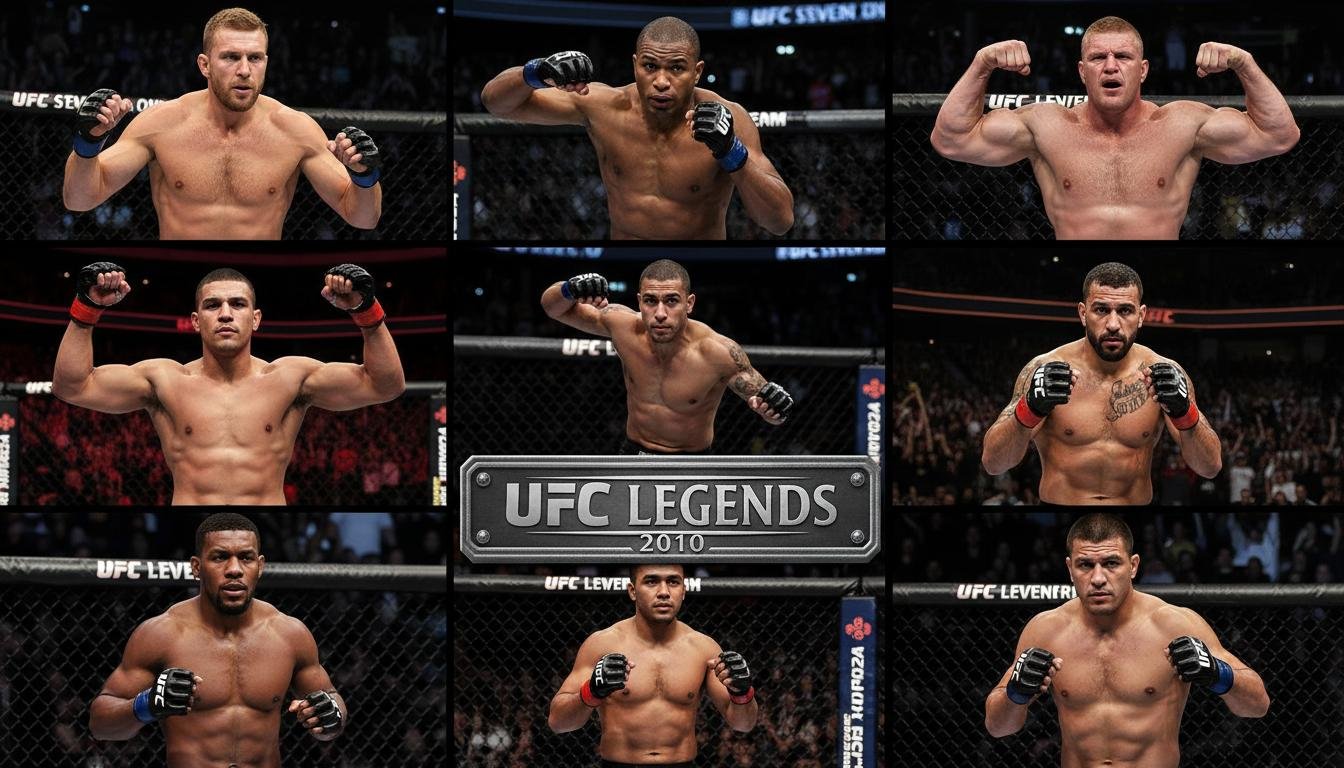
2010 was a hinge year for mixed martial arts: a mix of iron‑clad champions, shocking upsets and young stars pushing through the ranks. The sport matured visibly — bigger productions, strategic game plans, and fighters who blended wrestling, striking and jiu‑jitsu into unmistakable signatures. Below I walk through who mattered that year, why they mattered, and the moments that defined them.
Year in context: why 2010 still matters
By 2010 the UFC had settled into a rhythm where championship fights were events and title holders carried real stylistic identities. Fans could point to clear dominant specialists — a striker who moved like a dancer, a wrestler who never stopped pressing, a tactician who made every exchange count.
The calendar that year produced a few landmark finishes and one or two title changes that reshaped the top of the sport. Those moments didn’t just create highlight reels; they forced opponents to adapt and pushed mixed martial arts into a more tactical era.
Champions who defined the era
Anderson Silva — the unpredictable middleweight
Anderson Silva arrived in 2010 as the middleweight benchmark: fluid striking, timing that looked almost telepathic, and an ability to finish fights both theatrically and clinically. That year he faced perhaps his most dangerous challenger in Chael Sonnen — a contest that turned into a narrative classic.
Sonnen dominated large stretches with high‑pace wrestling, only for Silva to snatch victory late with a submission. The fight highlighted Silva’s composure under pressure and his unique ability to end a fight from a position that seemed lost, cementing his standing as the division’s defining force.
Georges St‑Pierre — engineered consistency
Georges St‑Pierre was the textbook champion: athletic, disciplined and methodical. In 2010 GSP continued to sharpen his all‑round game, blending elite takedown pressure with crisp, controlling striking to neutralize opponents’ strengths.
What made GSP stand out was his habit of making high‑level adjustments mid‑fight. Opponents often came in with one plan; they left with GSP’s plan dismantling them piece by piece. That combination of skill and fight IQ made him a natural choice among the best fighters that year.
Cain Velasquez — a force in heavyweight motion
Cain Velasquez brought a different flavor to the heavyweight class: relentless cardio, a wrestling base, and a ground‑and‑pummel style that upended expectations about heavyweight pacing. His ascent to the top in 2010 changed how people thought heavyweight fights could be fought.
When he met the biggest draw in the sport of the moment, the result signaled a passing of the torch. Cain’s victory — characterized by forward pressure and volume — proved that conditioning and wrestling could be decisive even at 265 pounds.
Jose Aldo — featherweight perfection
At featherweight, Jose Aldo’s name came up constantly in 2010 as the standard for speed, timing and low‑kick brutality. Competing primarily in the WEC at the time, Aldo unified elite striking with a tested chin and movement that frustrated challengers.
Although the featherweight ranks were still coalescing into a single global hierarchy, Aldo’s string of defenses and emphatic style left little doubt: he was the division’s reference point and one of the sport’s true pound‑for‑pound threats.
Contenders and breakout stars
Dominick Cruz — a new blueprint at bantamweight
Dominick Cruz arrived with an unorthodox footwork system and a movement‑first approach that made him hard to hit and harder to time. In 2010 he delivered pivotal wins that pushed bantamweight into the spotlight and forced analysts to reassess what elite footwork could accomplish in MMA.
Cruz’s ability to create angles and punish opponents who overcommitted made him a model for fighters who wanted to use movement as offense rather than merely defense. His influence can still be traced in how lighter classes prioritize mobility.
Jon Jones — the slow, inevitable rise
By 2010 Jon Jones was already turning heads as a long, athletic light heavyweight with a creative striking arsenal and wrestling instincts. He accumulated wins against ranked names and showed a rare blend of reach, creativity and cage control.
Those performances read like a blueprint for the title run that would follow; Jones’ 2010 showed a fighter who was learning to control space and pace in ways most opponents couldn’t solve yet.
Brock Lesnar — star power and heavyweight intrigue
Brock Lesnar was the commercial engine of the heavyweight division: a former NCAA champion whose size, wrestling pedigree and raw aggression made him a must‑see attraction. In 2010 his profile helped draw mainstream attention to the sport.
Lesnar’s bouts raised questions about style matchups at heavyweight — how elite cardio, wrestling and pressure would measure up against big power. Those matchups spoke to both athleticism and the sport’s growing narrative complexity.
Quick reference: top names and their 2010 status
Here’s a compact list to keep the era in view — weight class and why each fighter mattered that year.
| Fighter | Weight class | 2010 status |
|---|---|---|
| Anderson Silva | Middleweight | Dominant champion; key defenses and iconic comeback |
| Georges St‑Pierre | Welterweight | Methodical champion; tactical masterclass performances |
| Cain Velasquez | Heavyweight | New champion; cardio and pressure redefined the division |
| Jose Aldo | Featherweight | Elite striker; WEC featherweight standout |
| Dominick Cruz | Bantamweight | Movement specialist; major wins raised the division profile |
| Jon Jones | Light heavyweight | Rising star; mix of reach and creativity |
| Brock Lesnar | Heavyweight | Top draw; style matchups sparked heavyweight debate |
Why these names mattered beyond wins and losses
What sticks from 2010 isn’t just who won or who lost; it’s how the winners fought. Champions like Silva and GSP showed that stylistic mastery and adaptability trumped mere aggression. Meanwhile, fighters such as Cain Velasquez shifted tactical expectations for their divisions.
For fans and practitioners, 2010 served as a lesson: evolve or get exposed. Coaches began to emphasize multidisciplinary training and conditioning programs that matched the new pace, and young prospects took notes.
Personal perspective: watching the shift in real time
As someone who followed the cards closely that year, the clearest sign of change was subtle — fighters cutting ladar lines within seconds, not minutes, and camps preparing for mixed counters rather than single‑skill matchups. It made every title defense feel like a chess match with real teeth.
Seeing a veteran champion survive a sustained onslaught or a young contender rewrite the playbook made 2010 one of the more instructive years to study. It wasn’t just about the highlight finishes; it was about the evolution of fightcraft itself.
Further reading and authoritative sources
For event details, fight recaps and career timelines, consult these sources:
- UFC official site — fighter profiles and event archives
- ESPN MMA coverage — event reports and analysis
- Sherdog — fighter records and historical databases
- MMAFighting — contemporary reporting and interviews
Those outlets provide full fight cards, statistics and contemporary commentary if you want to dive deeper into any bout or fighter mentioned above. The year reads best when you watch the tape and trace how each athlete adapted from one fight to the next.