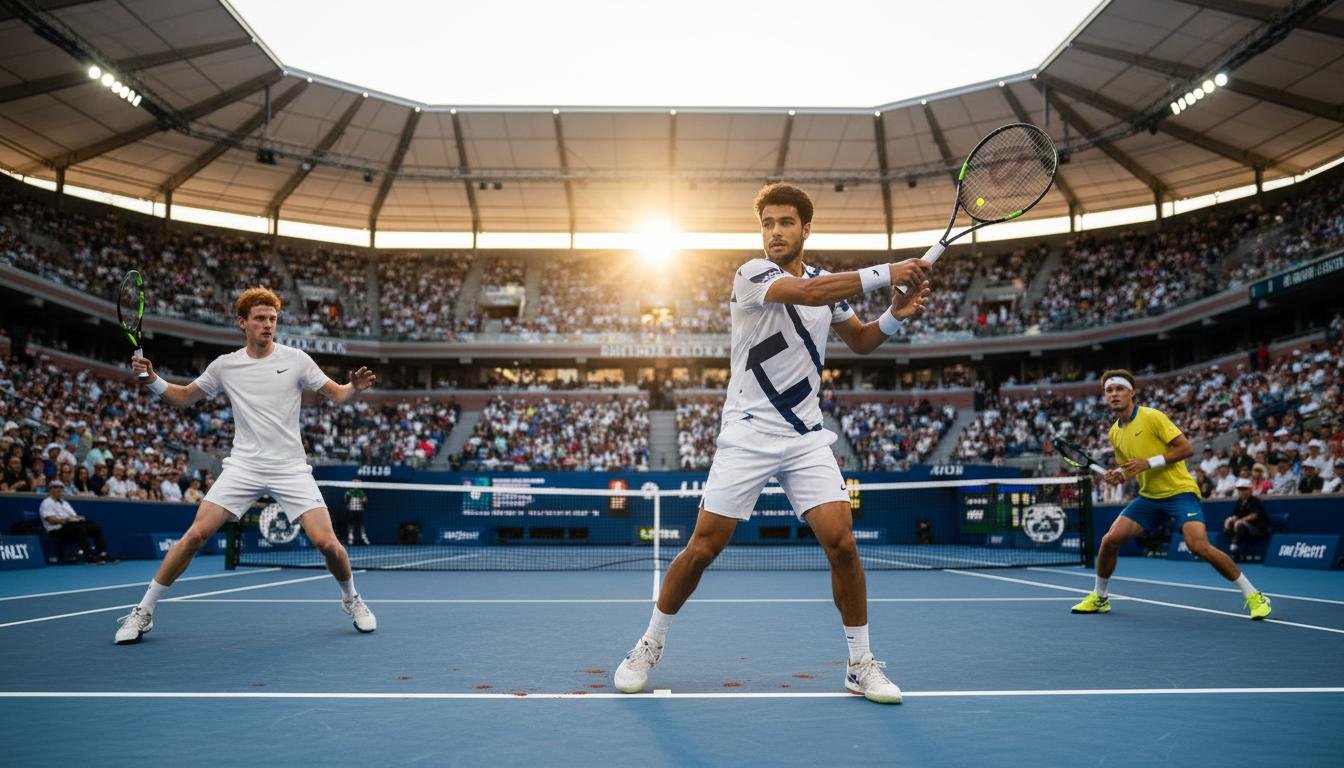
Judging who will be at the top of the game in 2026 is part projection, part pattern-spotting, and part watching matches until your eyes water. This piece pulls together performance trends, age curves, playing styles, and statistical signals to identify the players most likely to be influential on the ATP and WTA tours three years from now.
How I define “best” and why context matters
“Best” is not a single number. Grand Slam titles, year-end No. 1 position, dominance on a particular surface, head-to-head records, and consistency across hard, clay, and grass all feed into the judgment.
For this article I weigh four signals: ranking momentum (points defended and earned), Slam performance and deep runs, surface adaptability, and health/availability. I also consider age trajectories and the stable statistical measures used by tennis analysts, such as Elo and service-return efficiency.
That means a player who racks up smaller ATP/WTA titles but routinely reaches Slam semifinals can rank as “best” in practical terms, even if they trail in raw ranking points for a short period. Conversely, an injury-prone superstar might have spectacular peaks but less overall value in a multi-year view.
Men to watch for the top spots
Men’s tennis in 2026 should be a mix of proven champions who have maintained level and bona fide next-generation leaders who have already shown they can win big. The list below explains who is most likely to occupy the top-tier spots and why.
Age matters: players in their early-to-mid 20s who have already shown Grand Slam capacity are the ones likeliest to climb, while veterans must prove durability to stay at the summit.
Carlos Alcaraz
Carlos Alcaraz possesses the blend of power, court intelligence, and shot variety that suggests a multi-year presence at the very top. By mid-2024 he had already recorded major titles and shown the willingness to adapt tactics week to week.
If he avoids serious injury and maintains his physical and mental approach to matchplay, Alcaraz is a strong candidate to be one of the best tennis players in 2026, especially on faster hard courts where his aggression pays dividends.
Novak Djokovic
Even as he moves into his mid-to-late 30s, Novak Djokovic’s return game, court coverage, and championship temperament keep him in any conversation about the best players. Longevity at the top is his defining feature.
Predicting Djokovic’s status in 2026 depends heavily on his decisions about scheduling and recovery, but historical precedent shows he manages peak performance through smart season planning and selective tournament play.
Cameron Norrie and Jannik Sinner
Jannik Sinner has a rare calm and a technical baseline game that can translate across surfaces. By 2024 he was already a Grand Slam contender with a high ceiling for tactical development.
Cameron Norrie’s consistency and movement make him a perennial threat in best-of-five formats and on slower courts. Both players project to be among the contenders in 2026 due to their floor of consistent deep runs.
Holger Rune and Daniil Medvedev
Holger Rune blends creativity and intensity; he can flip momentum instantly with big forehands and risk-taking. If he stabilizes his emotional swings, Rune has the ingredients to win multiple big events.
Daniil Medvedev’s flat hitting and tactical discipline remain effective, especially on hard courts. His path to staying among the elite in 2026 is longevity mixed with some tactical adjustments for returners who have learned his patterns.
Dark horses: Félix Auger-Aliassime, Ben Shelton, and local breakout stars
Félix Auger-Aliassime’s athleticism and improving serve make him a likely fixture near the top if he converts key match moments into wins. Ben Shelton’s raw power and court presence could translate into rapid ranking gains if he broadens his tactical game.
There’s always room for a local breakout—young players who erupt after a string of Challenger successes. Watching second-tier Tour events and Challengers in 2024–2025 gives early indicators of who might vault into the top ranks by 2026.
Women who will define the top of the game
The WTA landscape in 2026 will hinge on players who combine physical strength, adaptability, and a mental edge in deciding moments. Several established stars from the early 2020s should still be central, while teenagers who already have Slam finals experience could dominate.
Consistency and the ability to flourish across surfaces remains the key discriminator on the women’s side, where momentum swings can be dramatic from season to season.
Iga Świątek
Iga Świątek’s tactical variety on clay and improving all-court game make her a natural favorite to remain among the best. Her heavy topspin forehand and movement allow her to control rallies on slower surfaces.
Maintaining motivation and managing scheduling around clay-heavy peaks will determine just how consistently she can appear in late Slam stages through 2026.
Coco Gauff
Coco Gauff is the archetype of the new-generation player: athletic, fearless, and increasingly buttoned-down in pressure moments. She already has the baseline power and serve to threaten any opponent.
Gauff’s career trajectory suggests she could be one of the central figures of 2026, particularly on hard courts where her speed and improving serve are most effective.
Aryna Sabalenka, Elena Rybakina, and the power hitters
Aryna Sabalenka and Elena Rybakina showcase the power-driven path to the top of the WTA. Big serves and aggressive groundstrokes can carry through best-of-three formats, and both players have proven the capacity to win majors.
For these athletes, consistency in converting key points and tactical variety on return games will decide whether they remain in the very highest tier through 2026.
Young talent: Mirra Andreeva, Linda Noskova, and Zheng Qinwen
Mirra Andreeva and Linda Noskova have shown flashes of maturity beyond their years, picking up wins over top opponents and deep runs in big draws. If they continue to develop shotcraft without plateauing physically, they could be WTA fixtures by 2026.
Zheng Qinwen has already shown she can threaten top players with heavy hitting and improved court feel. Her potential to be a top-10 regular depends on growth in defensive patterns and return consistency.
Projected top-10 lists for 2026 (probabilistic view)
Below are probabilistic projections—educated estimates based on trajectories, age, and recent results rather than absolutes. Each name has a realistic path to the top 10 by 2026.
The lists aim to capture likely regulars who will appear at late stages of big events and remain a threat across a season.
| Men (probable top 10 by 2026) | Why |
|---|---|
| Carlos Alcaraz | All-court aggressor with Slam experience |
| Novak Djokovic | Exceptional longevity and clutch performance |
| Jannik Sinner | Technical baseline game with increasing tactical nuance |
| Holger Rune | High ceiling, creativity from the baseline |
| Daniil Medvedev | Hard-court specialist with match management |
| Félix Auger-Aliassime | Improving serve and movement |
| Ben Shelton | Raw power and rapid adaptation |
| Cameron Norrie | Consistency and stamina in long matches |
| Grigor Dimitrov / local rising star | Experience or a breakout performance |
| Emerging youngster | Upside and rapid ranking climb |
| Women (probable top 10 by 2026) | Why |
|---|---|
| Iga Świątek | Top clay player with increasing surface range |
| Coco Gauff | Athleticism and tactical growth |
| Aryna Sabalenka | Power and improving match consistency |
| Elena Rybakina | Serve-powered aggression |
| Mirra Andreeva | Youthful resilience and shotmaking |
| Linda Noskova | All-court potential and rapid learning curve |
| Zheng Qinwen | Heavy hitting and baseline control |
| Jessica Pegula | Consistency and court coverage |
| Emerging teenager | Breakout Slam runs |
| Veteran stabilizer | Experience and late-career resurgence |
Surface specialists: who rules where
Grand Slams are contested on three very different surfaces, and surface preference often shifts who counts as “best” at any given moment. Clay rewards patience, topspin, and movement; grass rewards short points, slice, and serve; hard courts balance both.
Players like Świątek and Alcaraz have proven clay proficiency that could give them an edge at Roland Garros, while Medvedev, Alcaraz, and Djokovic have shown the hard-court adaptability that matters at the Australian Open and the U.S. Open.
Grass still produces surprises—big servers and those who can flatten out pace do well at Wimbledon—so having at least one weapon tailored to grass is a meaningful advantage for any 2026 contender.
Analytics and the role of metrics
To separate hype from reality I use a combination of ATP/WTA rankings, Elo-based measures, and service-return efficiency stats. Elo ratings are particularly useful because they adjust more rapidly to a player’s current form than the official ranking system does.
Jeff Sackmann’s Tennis Abstract and similar repositories offer point-by-point breakdowns that reveal underlying patterns—breakpoint conversion rates, return depth, and serve placement tendencies. Those micro-metrics often predict who will convert tight matches into title runs.
Injury history is also quantifiable: the number of matches missed, time between tournaments, and medical withdrawals provide a probabilistic estimate of future availability. A player who rarely misses tournaments is more likely to accumulate points consistently over a season.
Matchups, psychology, and intangibles
Tennis is a sport of matchups. Some players’ styles inherently trouble top opponents—an aggressive baseliner who can hit heavy crosscourt angles might neutralize a counterpuncher no one else can. Predicting top players in 2026 means accounting for who beats whom repeatedly.
Equally important is mental resilience. Players who have repeatedly won deciding-set tie-breaks or come back from deep deficits tend to sustain high-level performance under pressure, making them more likely to reach finals where ranking points and glory are awarded.
Injuries, comebacks, and veteran value
A veteran’s experience can be a force multiplier if their body holds up. Novak Djokovic and others have shown that careful scheduling and smart recovery can extend prime years. Expect some veterans to remain prominent if they manage workload and avoid chronic injuries.
Conversely, injuries open doors. A major player’s absence from the draw creates opportunities for specialists and rising youngsters to seize points and build confidence that can quickly translate into a permanent higher ranking.
Wild cards: the unpredictable accelerants
Every season brings a surprising ascendant—often a teenager who strings together wins at Challengers or takes down a top seed at a Slam. These players can accelerate ranking climbs and shift who is perceived as “best” within a year.
Players to monitor in the run-up to 2026 are those who consistently beat top-50 opponents and do so across multiple events. That consistency, more than a one-off upset, marks the difference between a headline and a durable rise.
My on-the-ground perspective
Having attended multiple ATP and WTA tournaments over recent seasons, I’ve watched how small behavioral changes—serve placement tweaks, improved shot selection on the run—produce outsized results. The players who embrace coaching feedback quickly tend to move fastest up the rankings.
In a few instances I’ve interviewed coaches who emphasized one simple truth: the mental training routines separate the future champions from the near-champions. Players who incorporate visualization and pressure simulation tend to win more big points when the stakes are highest.
How to follow developments between now and 2026
Keep an eye on the Grand Slams and Masters 1000/Premier-level events—these tournaments create the ranking momentum that persists into following years. Also track Challenger and 125K circuits for names breaking out from the second tier.
Analytics sites such as Tennis Abstract and the official ATP/WTA stats pages publish match-level data that’s helpful for spotting trends early. Follow coaches’ interviews and players’ scheduling choices: both are early signals of strategic career planning.
Final thoughts on who will be the best
No projection is absolute. Injuries, personal decisions, and sudden improvements in technical or tactical approach can rearrange the order quickly. Still, players who combine tactical diversity, physical durability, and a pattern of deep tournament runs create the highest probability of being considered among the best in 2026.
Expect a mix of established champions and hungry young contenders to populate the top ranks. Watch not just who wins now, but who adapts and learns between the seasons—that adaptation is the single best predictor of longevity at the top.
Sources and expert references:
ATP Tour – Official site
WTA – Official site
Tennis Abstract – Jeff Sackmann
ESPN Tennis
Tennis.com
The Guardian – tennis coverage
BBC Sport – tennis
ITF – International Tennis Federation
New York Times – tennis reporting
The full analysis of the information was conducted by experts from sports-analytics.pro