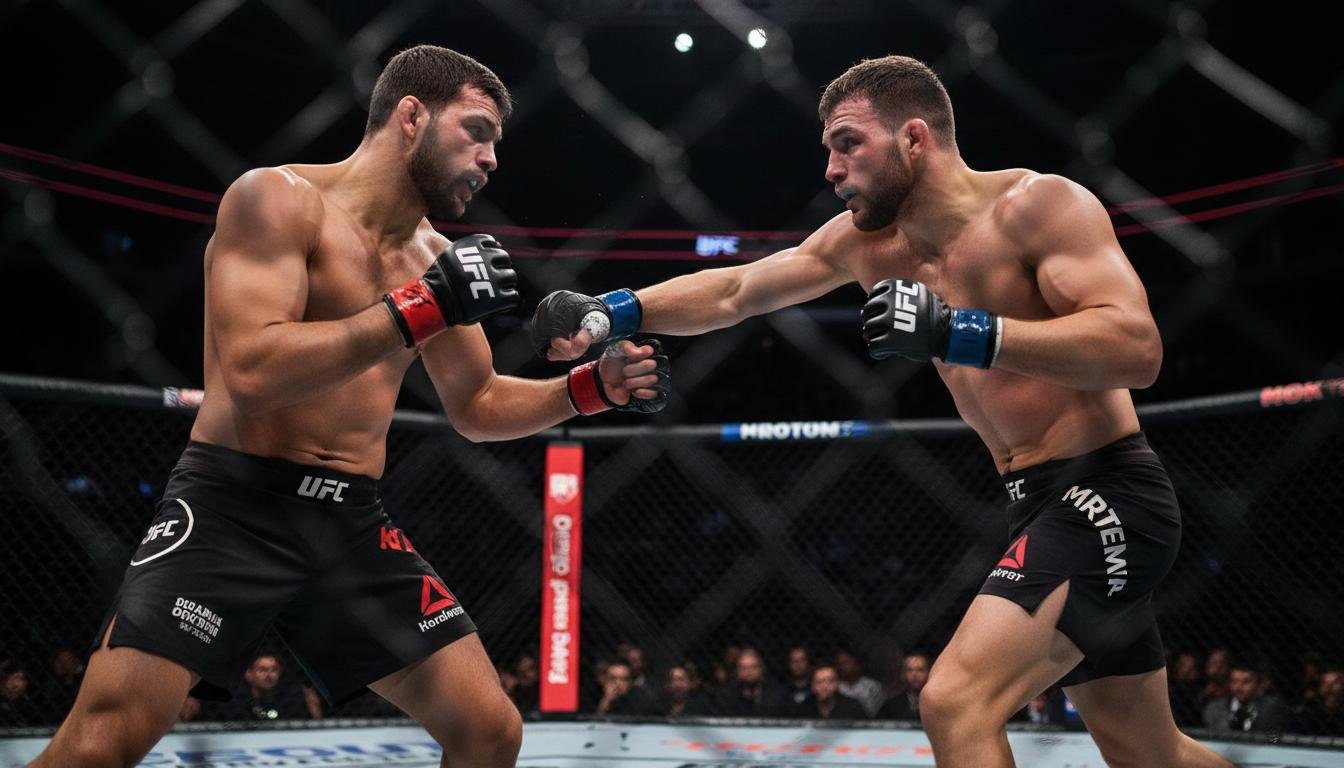
Betting on a fighter to win by points is a quieter, more cerebral corner of MMA wagering. Instead of chasing knockouts and dramatic stoppages, this approach asks you to read judges, styles, and pace—then back a fighter to grind out rounds. The rewards are steadier, but only if you know exactly what variables push a bout to the scorecards.
What “victory by points” means and how judges decide
Under the 10-point must system, judges award the round 10-9 to the perceived winner in most cases, with 10-8 or 10-7 reserved for dominant rounds. The final decision depends on the accumulation of those round scores across three or five rounds, and small margins add up quickly.
Judges score rounds using effective striking, grappling, aggression, and cage control as guiding criteria. That makes control time and steady output disproportionately valuable in close fights—fighters who manage rounds without finishing often win by decision more than they receive credit for in casual viewing.
Why bettors pursue points bets
Points bets reduce variance. You’re not relying on a single punch or a lucky scramble; you’re betting on consistent performance throughout a fight. For disciplined bankrolls and long-term strategies, that lower-variance profile is attractive.
Bookmakers price decisions differently than straight moneyline fights because method-of-victory props carry added uncertainty. When you find a mismatch between the implied probability of a points outcome and your read of the matchup, there’s value to be had.
Traits that make a decision more likely
Some fighter profiles tend to produce decisions. High-volume technical strikers who accumulate strikes without a single heavy, fight-ending shot often outpoint their foes over rounds. Similarly, wrestlers who control position and run the clock without finishing can rob opponents of scoring opportunities while staying from danger.
Defensive fighters with solid takedown defense but limited knockout power also fit the decision mold. If both competitors lack a reliable finishing sequence, rounds will be the battleground—and judges will decide the winner.
Cardio and fight IQ add to that equation. Fighters who pace themselves well and adjust to an opponent’s rhythm are better at stealing rounds late, producing outcomes that favor decisions rather than early stoppages.
Quick comparative table: indicators favoring decision vs. finish
| Indicator | Favors decision | Favors finish |
|---|---|---|
| Significant strike differential | Small to moderate advantage | Large advantage with power strikes |
| Finishing percentage | Low to moderate | High (KOs/Subs) |
| Control/takedown time | High control, low submission attempts | High submission attempts or ground-and-pound intensity |
Data-driven signals to watch
UFC’s official stats provide a starting point: strike rates, strikes absorbed, takedown averages, and control time all matter. Compare a fighter’s average fight length and finishing rates to judge how often they go the distance—fighters whose median fight time clusters near the final bell are natural candidates.
MMA Decisions and independent databases let you check historical judges’ trends and how often certain judges score closely or prefer activity over control. Venue trends matter, too; some commissions and cities historically show different scoring patterns on close rounds.
Don’t ignore head-to-head stylistic numbers. A high significant-strike differential is meaningful if it indicates consistent round-winning volume rather than a single flurry. Similarly, takedown accuracy and takedown defense numbers should be read together: someone who lands takedowns but fails to secure control time may not win many rounds despite their success rate.
Line shopping and market inefficiencies
One of the simplest edges for decision bettors is shopping multiple books. Odds on a method-of-victory prop—decision, KO/TKO, submission—can vary widely between operators. Small percentage differences matter long term and can shift an expected value calculation from negative to positive.
Watch for delayed price adjustments after late-breaking information—injuries, weight issues, or short-notice replacements. Sharp books often move quickly; softer books lag. Finding those lagged lines is where disciplined bettors make consistent profits.
Bankroll management and staking plans for points bets
Because decision bets can be lower-variance but still unpredictable, fix a unit size and stick to it. Treat a points wager like any other prop: determine edge, calculate implied value, and never exceed your staking limits based on emotion.
- Unit sizing: 1–3% of bankroll per wager is conservative and realistic for most bettors.
- Flat staking vs. Kelly: flat staking keeps you alive longer; fractional Kelly can be used with a reliable edge and conservative win-rate estimates.
- Record-keeping: log every points bet with rationale and outcome. Patterns in success rate are your best teacher.
Live betting: exploiting round flow
Live markets are where decision bettors can shine. If a fighter wins the first two rounds narrowly, live odds for a points victory often become favorable for the losing fighter—use the broadcast and live stats to judge whether that losing fighter is likely to take rounds back.
Round-by-round betting also presents opportunities. If a fighter is heavy on volume and already ahead on strikes late in round two, backing them to nab round three at a modest line can be a low-risk way to capture incremental value.
Evaluating judges and commissions
Not all judges score the same. Some prioritize effective striking and octagon control; others reward aggression or attempts to finish. Build a mental map of judges you see frequently and adjust expectations accordingly. This matters most in close, three-round fights where one round swing decides the fight.
Commission tendencies matter, too. Research local scoring patterns and compare them with the fighters on the card. When a fight goes to the scorecards in a jurisdiction that historically favors one style of scoring, adjust your wager sizes accordingly.
Common traps and how to avoid them
Recency bias is a frequent pitfall—one emphatic knockout does not erase a fighter’s long-term inability to finish. A single recent stoppage can inflate public perception and lure bettors away from solid decision value.
Another trap is relying solely on headline stats like “most significant strikes” without context. Where those strikes land, timing, and whether they accumulate round-by-round matter much more than a post-fight total. Avoid confirmation bias by testing your read against multiple metrics.
Sample approach from experience
I once watched a matchup where a technical boxer with a modest knockout rate faced a powerful but one-dimensional puncher who either finished opponents quickly or faded. The public pegged the puncher for a late KO; my numbers showed the boxer landed more volume and controlled distance for three rounds.
I placed a modest points wager across two books after line-shopping. The fight unfolded as the data suggested: the boxer avoided heavy exchanges, controlled cadence, and won on points. That trade reinforced a habit—trust the numbers, not the narrative headlines.
Practical checklist before placing a points bet
Run a quick pre-bet checklist: verify recent injuries or weight issues, compare finishing percentages, check control time and takedown metrics, scan judge assignments, and shop lines. If two or three indicators favor a decision and the market underprices that scenario, you may have an edge.
Keep stakes modest when uncertainty remains. Betting on decisions rewards patience and discipline more than bravado—treat it like a long-term investment, not a shortcut to a big score.
Victory by points is not glamorous, but it can be reliable. With careful data work, disciplined bankroll management, and a willingness to exploit slow-moving lines, you can make decision betting a steady part of your MMA wagering toolkit. Read the fight—and the judges—before you bet, and let the math guide your wagers.
- https://www.ufc.com/stats
- https://mmadecisions.com/
- https://www.pinnacle.com/en/betting-resources
- https://www.actionnetwork.com/
- https://www.espn.com/mma/
- https://fivethirtyeight.com/
- https://www.mmafighting.com/authors/ariel-helwani
- https://www.mmajunkie.usatoday.com/author/mike-bohn
- https://www.actionnetwork.com/authors/ben-fowlkes
Full analysis of the information was conducted by experts from sports-analytics.pro