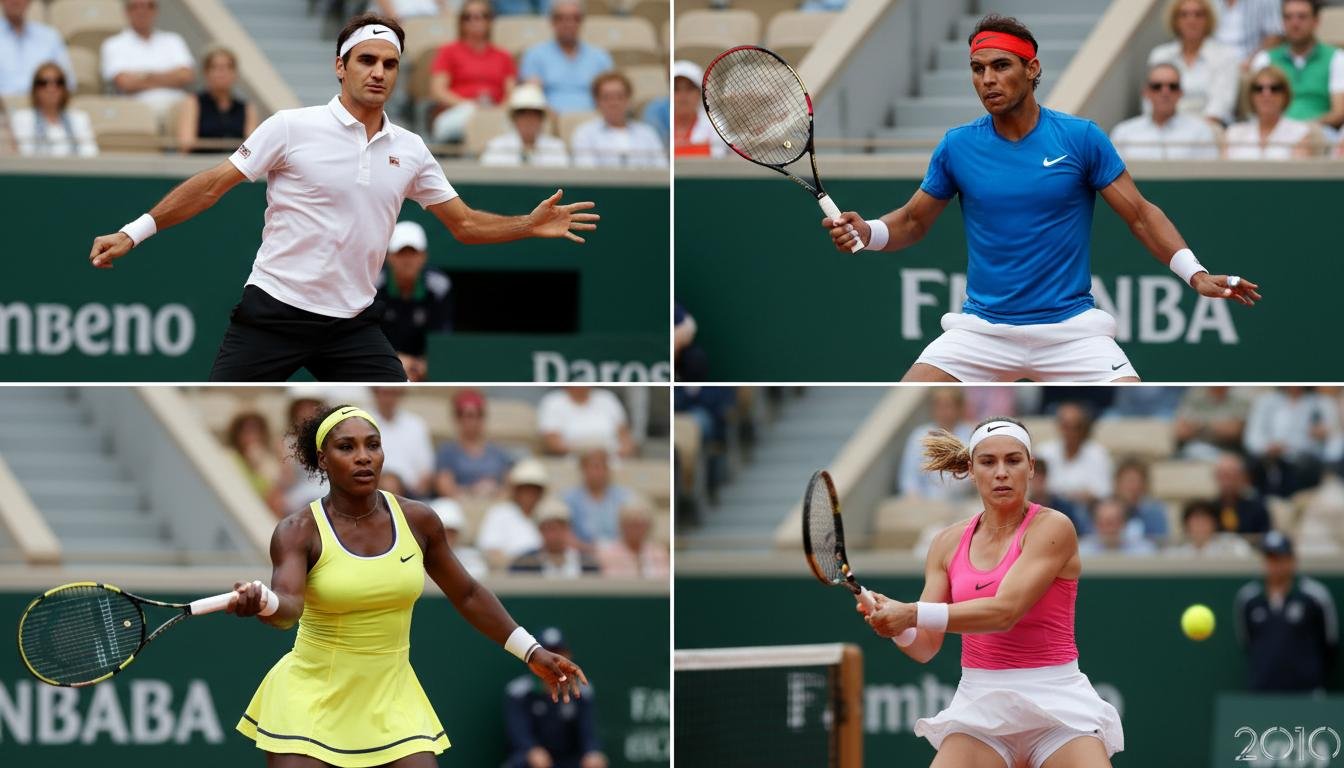
2010 was a year when tennis felt both familiar and electric: old champions reasserted themselves, new faces pushed through, and the sport’s momentum shifted in ways that still matter. This article revisits the players who dominated that season — the winners, the storytellers, and the matches that defined a turning point in modern tennis.
Why 2010 was a landmark season
At first glance, 2010 looks like a continuation of the Federer–Nadal era. But beneath the surface were tectonic changes: Rafael Nadal reached a peak of consistency across surfaces, while players such as Novak Djokovic and Andy Murray began to mount sustained challenges that would explode in the following years.
Beyond personal rivalries, 2010 produced surprise Grand Slam champions on the women’s side and a reshuffling of expectations on the ATP tour. It was a season that rewarded durability and mental toughness; those qualities separated the very good from the truly exceptional.
Standouts on the men’s tour
Rafael Nadal was unquestionably the defining male player of 2010. He won three of the four Grand Slams (Roland Garros, Wimbledon, and the US Open), combining clay-court mastery with an increasingly lethal game on grass and hard courts.
Roger Federer remained a relentless force, taking the Australian Open and continuing to set benchmarks for shot-making and match intelligence. His presence kept the top of the tour fiercely competitive and gave every major a feeling of open drama.
Novak Djokovic and Andy Murray were no longer simply challengers; they were becoming fixtures in late-stage Grand Slam draws. Djokovic in particular began to round into the player who could consistently push Nadal and Federer deep into matches, while Murray’s tactical growth made him one of the toughest opponents on any surface.
Other male players worth noting
Juan Martín del Potro showed flashes of the power and temperament that had brought him the 2009 US Open, while Robin Söderling remained a dangerous big-hitter on hard and clay courts. Tomas Berdych and Nikolay Davydenko also produced results that kept them in the mix at big events.
These players rounded out a competitive top 10 that made the ATP season unpredictable from week to week. Their presence widened the pool of potential Grand Slam spoilers and added texture to the year’s narrative.
Standouts on the women’s tour
The WTA tour in 2010 was an alternating chorus of veterans and surprise victors. Serena Williams looked revitalized, capturing two majors (Australian Open and Wimbledon) and reminding everyone of her capacity to dominate when healthy and focused.
Caroline Wozniacki finished the year as the WTA’s year-end No. 1 through remarkable consistency, despite not winning a Grand Slam that season. Her steady accumulation of deep runs and tournament victories was a textbook example of how week-to-week excellence can outscore marquee titles in the rankings race.
Breakthroughs and unexpected champions
Francesca Schiavone’s French Open victory was one of the season’s happiest surprises — an elegant, gritty player capturing Italy’s first major singles title. Kim Clijsters continued to be a force at the US Open, and Vera Zvonareva’s steady play placed her in contention for multiple finals.
Justine Henin’s brief comeback in 2010 added an emotional subplot, while younger talents began to emerge and signal the next wave of contenders.
Grand Slam winners at a glance
One simple way to summarize the year is to look at the Grand Slam champions. Those titles carry weight not only for their prestige but because they crystallize who performed best on tennis’s biggest stages.
| Event | Men’s singles | Women’s singles |
|---|---|---|
| Australian Open | Roger Federer | Serena Williams |
| Roland-Garros | Rafael Nadal | Francesca Schiavone |
| Wimbledon | Rafael Nadal | Serena Williams |
| US Open | Rafael Nadal | Kim Clijsters |
Memorable matches and turning points
The 2010 US Open final between Nadal and Djokovic stands out as an emblem of the year: Nadal’s relentless defense meeting Djokovic’s back-court precision in a high-quality, four-set victory. That match underscored Nadal’s capacity to beat the best on hard courts, sealing his status as the season’s top player.
On the women’s side, Schiavone’s French Open final and Serena’s Wimbledon campaign both had moments that felt generational — a mix of grit, tactical flexibility, and sheer will. Matches like those changed perceptions about what those players were capable of in pressure moments.
What made these players special in 2010
Physical conditioning and mental resilience were decisive. Nadal’s foot speed, Federer’s shotcraft, Djokovic’s baseline depth, and Wozniacki’s defensive consistency each represented different routes to sustained success. They proved that there isn’t a single recipe for dominance.
Another factor was adaptability. Players who could tweak strategy between sets — and across surfaces — thrived. That adaptability caused top players to expand their repertoires, investing in returns, serve variety, and improved net play.
Personal recollection from the stands and screen
I remember watching Nadal’s third Grand Slam of the year on a late-September broadcast, the crowd’s energy almost tangible through the speakers. The combination of a near-flawless streak and opponents who refused to fold made every match feel consequential in a way few seasons achieve.
Being at a smaller ATP event that year, I watched a young player grind through a three-setter and then limp off court with a smile — a small moment that reflected the era’s blend of immense pressure and fierce joy. Those everyday dramas complemented the headline-grabbing finals.
How 2010 shaped the decade ahead
Many trends that defined the 2010s were either visible or born that season: deeper, more athletic baseline play; a longer prime for top players; and a younger crop prepared to push the established stars. That blueprint set the scene for the extended rivalries and shifting hierarchies that followed.
For fans and historians, 2010 is often revisited as the year tennis both honored its legends and ushered in new contenders. It’s a season that rewards rewatching: the matches still hold tactical lessons and emotional peaks.
Further reading and sources
For official results and detailed statistics from 2010, consult the primary governing bodies and tournament sites below. These sources provide match records, rankings, and archival reports used to assemble this overview.
- ATP Tour (official)
- WTA Tennis (official)
- Roland-Garros (official)
- The Championships, Wimbledon (official)
- US Open (official)
- Australian Open (official)
- ESPN tennis coverage
The players and matches of 2010 remain a rich chapter in tennis history: a season in which achievement, evolution, and surprise all played starring roles.