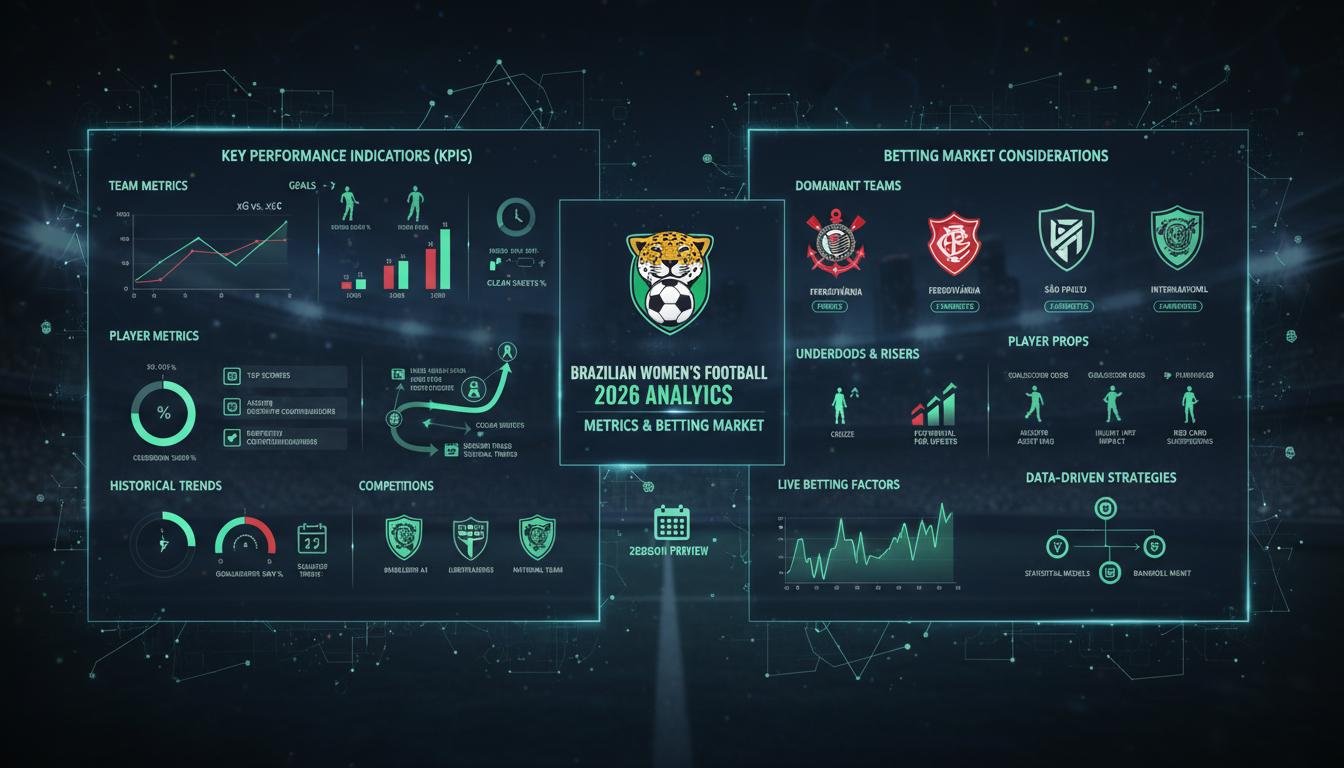
Analytics are reshaping how teams prepare, how scouts recruit, and how bettors size their stakes. In Brazil, a country with a deep football culture and rapidly growing investment in the women’s game, 2026 feels like a hinge year: data coverage has improved, broadcast reach has expanded, and markets are waking up to new value opportunities. This article walks through the most useful metrics, the realities of Brazilian data, how forecasting models are built, and where the betting market currently over- or under-prices on-field signals.
Why 2026 matters for the women’s game in Brazil
Investment cycles and calendar changes are converging. CONMEBOL and national federations have increased calendar harmonization and broadcast deals, which improves data capture for domestic leagues and cups. With better camera feeds and more consistent scheduling, tracking systems and event providers gain more usable data, a precondition for reliable analytics.
On the commercial side, sponsorship and media interest have nudged bookmakers to offer deeper markets for top Brazilian matches. They still lag behind major European competitions in liquidity, but the trend is upward. For analysts and bettors, that creates a narrow but growing window where well-constructed models can find edge before markets fully adjust.
Core metrics every analyst should know
Data in modern football extends beyond goals and passes. Expected goals (xG) is the most widely used baseline: it assigns a probability to each shot based on its context, capturing quality more reliably than raw counts. For teams, xG for and against helps separate finishing variance from underlying performance; for bettors, it refines the expectation of future results better than recent scorelines alone.
Other fast-moving metrics include packing (how many opponents are bypassed by a pass), pressures and pressure regains, possession value (PV), and expected assists (xA). When available, tracking-derived measures such as progressive distance, speed in transition, and defensive line height add another layer, useful for modeling match tempo and goal-scoring opportunities.
Key metrics and what they tell us
Below is a compact table explaining several high-impact metrics and their direct relevance to betting and forecasting. This is not exhaustive, but it organizes the practical tools most bettors and analysts use when approaching Brazilian women’s matches.
| Metric | What it measures | Betting relevance |
|---|---|---|
| xG (expected goals) | Probability-weighted shot quality based on location, body part, and situation | Predicts future goal rates and correct-score probabilities |
| xA (expected assists) | Chance that a pass will become a shot with its own xG | Identifies creators and undervalued playmakers for player props |
| Packing | Number of opponents bypassed by a pass | Signals effectiveness of build-up and transition for value in over/under markets |
| Pressures & pressure regains | Defensive activity that leads to turnovers | Useful for in-play betting on momentum and short-run scoring chances |
| Progressive carries/passes | Measures forward progressiveness of team/player actions | Helps differentiate teams that consistently create high-quality chances from those that accumulate possession with low threat |
Where the data come from and limitations in Brazil
Major commercial providers—StatsBomb, Opta/StatsPerform, Wyscout—cover top international fixtures and many domestic leagues, but coverage density varies by country and tier. In Brazil, Serie A1 and the national team are well-observed, while lower divisions and some regional competitions have inconsistent event tagging and limited tracking data. That patchiness affects model stability when teams meet who lack historical, high-fidelity inputs.
Tracking systems (camera-based or GPS) provide the richest features, but they are the most expensive and are currently limited to a subset of stadiums and competitions. Event data—shots, passes, tackles—are more widely available and can be augmented by video-scraping and manual coding, but those efforts add latency and potential labeling noise. Good analysts always treat Brazilian datasets as “mostly good with spotty gaps.”
Building robust forecasting models for matches
Modeling begins with a philosophy: what are you forecasting? Match outcome probabilities, expected goals, or player-level props each require different feature sets and loss functions. Simple, interpretable models—Poisson regression or Elo variants—perform surprisingly well for match results when calibrated with attack/defense strength parameters. They are quick to update and transparent for betting decisions.
Machine learning approaches (gradient boosting machines, neural networks) can add value when you have richer features such as recent pressures, packing numbers, or GPS-derived speed metrics. They require careful training to avoid overfitting—especially when league coverage is patchy—and rigorous cross-validation across seasons and competitions. Ensemble approaches that combine a principled baseline model with ML residual corrections often produce the most stable market-ready probabilities.
Calibration and evaluation
Sharp bettors and modelers focus on calibration: do predicted probabilities match observed frequencies? Brier score and log-loss are common choices for evaluating probabilistic forecasts. For bettors, profitability is the key: back-testing should simulate realistic market odds, including margins and transaction friction.
Another practical step is “situational testing.” Evaluate models specifically for home/away split, travel effects within Brazil, and roster disruptions like international call-ups. Those situational biases are often where edge exists, because public markets and some models treat them too simplistically.
How sportsbooks price Brazilian women’s matches
Bookmakers use a mix of internal models, market-making heuristics, and bookmaker risk management to set initial odds. For Brazilian women’s matches, they often start with generalized models tuned to global women’s competitions and then adjust using local knowledge—injuries, weather, expected lineup. Because data sparsity is greater here than in men’s high-tier leagues, human adjustments play a larger role.
Market liquidity is lower, especially outside Brazil’s top clubs and international fixtures. Lower liquidity causes wider spreads and slower reaction to new information, which creates short-lived windows for value-seeking bettors who can act before odds tighten. In-play markets are improving and often misprice momentum due to delay in integrating pressure data and shot-quality shifts.
Common market inefficiencies and behavioral biases
Several cognitive and structural biases create opportunities. Star-player bias is strong: bettors overweight famous forwards even if xG creation is more distributed. Home advantage is often overstated in away-heavy fixtures, where travel logistics and venues reduce expected advantage. Recency bias causes markets to overreact to a single large win or loss instead of reweighing underlying xG trends.
Public sentiment also drives overpricing of national-team players during international windows; lines shift in favor of teams with famous names, even if club form suggests otherwise. Identifying when public money systematically misprices lines requires cross-referencing event-based metrics with market movements—a routine task in modern value hunting.
Live betting: where microdata becomes gold
In-play markets reward analysts who can parse micro-events: an errant defensive header, repeated pressure sequences inside the box, or a dominant run of progressive carries. Live models that incorporate sequences—like expected goals flow over the last 10 minutes—can signal when a match’s short-run dynamics diverge from pre-game expectations.
Practical live strategies prioritize small, frequent bets with tight stop criteria. Trading out of positions when the edge evaporates is often smarter than letting variance run. Because tracking and pressure metrics update faster than betting markets, there are real opportunities for disciplined traders in Brazilian fixtures where broadcast delays and lower liquidity slow market corrections.
Player-level analytics and prop markets
Player props (goals, assists, shots on target) are a natural playground for analytics. xG and xA, combined with minutes projection and substitution patterns, allow more precise valuations than using season totals alone. For example, a forward whose underlying xG per 90 is high but who sits on modest raw goals may be a candidate for positive regression in prop markets if playing time is stable.
In Brazil, rotation patterns are often influenced by state competitions and congested calendars. Accounting for rotation risk is crucial when pricing props: a player who normally starts may be rested for a regional cup match, even if public attention stays on her international profile. Tracking expected minutes is as important as expected scoring rate.
Risk management and staking for bettors
Edge without proper staking usually ends in ruin. The Kelly criterion remains the mathematically sound approach for sizing bets based on estimated edge and bankroll. Most practical bettors use fractional Kelly to curb volatility and sequencing risk. Conservative sizing is especially important in lower-liquidity markets typical of many Brazilian women’s fixtures.
Correlation risk is another silent killer. Bets across the same match or player (match winner and player goal prop) are highly correlated; staking should account for that dependence. A disciplined approach involves capping exposure per match and monitoring overall portfolio delta against adverse variance scenarios.
Clubs and scouts using analytics in Brazil
Clubs in Brazil have begun integrating analytics into scouting, match preparation, and injury prevention. Performance departments use event data to profile opposition and to tailor pressing triggers or passing lanes to exploit defensive packing weaknesses. Young player identification increasingly relies on progressive metrics rather than raw counting stats.
From personal experience following a São Paulo club’s women’s side, I’ve seen analytics help identify undervalued wingers who consistently delivered high progressive carry numbers despite low assist totals. The club converted those insights into targeted recruitment, which improved transition threat within a season—an object lesson in how even modest data programs can yield tactical and market advantages.
Ethics, transparency, and the future of data
With growth comes responsibility. Data privacy for athletes, transparent model communication for clubs and bettors, and parity in coverage between men’s and women’s competitions matter. Analysts and providers should aim to publish methods, limitations, and data quality metrics so stakeholders understand where conclusions are robust and where they are speculative.
Looking forward, better coverage of lower tiers, standardized event tagging, and wider use of tracking will produce more granular models. As analytics migrate from niche to mainstream, early adopters—clubs, bettors, and media—will reap the first dividends, while the broader market will slowly neutralize simple edges.
Practical checklist for bettors and analysts targeting Brazil in 2026
Start with the basics: gather xG/xA, recent form over the last 3–6 matches, and home/away splits. Add contextual modifiers: international call-ups, rotation risk from concurrent state cups, and travel distances for away teams. Where possible, layer in pressure and packing metrics to evaluate game-control vs. chance quality.
Test models on out-of-sample seasons and simulate odds with bookmaker margins to ensure theoretical edges translate to backtested profitability. Finally, track your bets and model outputs; no strategy improves without honest performance review and iterative refinement.
For analysts and bettors serious about Brazil’s women’s game, 2026 is a year to build sustainable systems rather than hunt for quick wins. Data quality and market liquidity are improving, but edges will come from disciplined modeling, situational awareness, and careful risk management rather than from headline-driven hype. The path forward is steady: better inputs, smarter models, and clearer staking rules will define who benefits as markets mature.
Sources and expert resources:
FIFA women’s football overview https://www.fifa.com/womens-football
CONMEBOL official site https://www.conmebol.com
Brazilian Football Confederation (CBF) https://www.cbf.com.br
StatsBomb analytics and blog https://statsbomb.com
Opta / StatsPerform insights https://www.statsperform.com
Understat expected goals explanation https://understat.com
CIES Football Observatory research https://football-observatory.com
Investopedia Kelly criterion primer https://www.investopedia.com/kelly-criterion-4689743
Wyscout resources and scouting tools https://wyscout.com
Full analysis of the information was conducted by experts from sports-analytics.pro