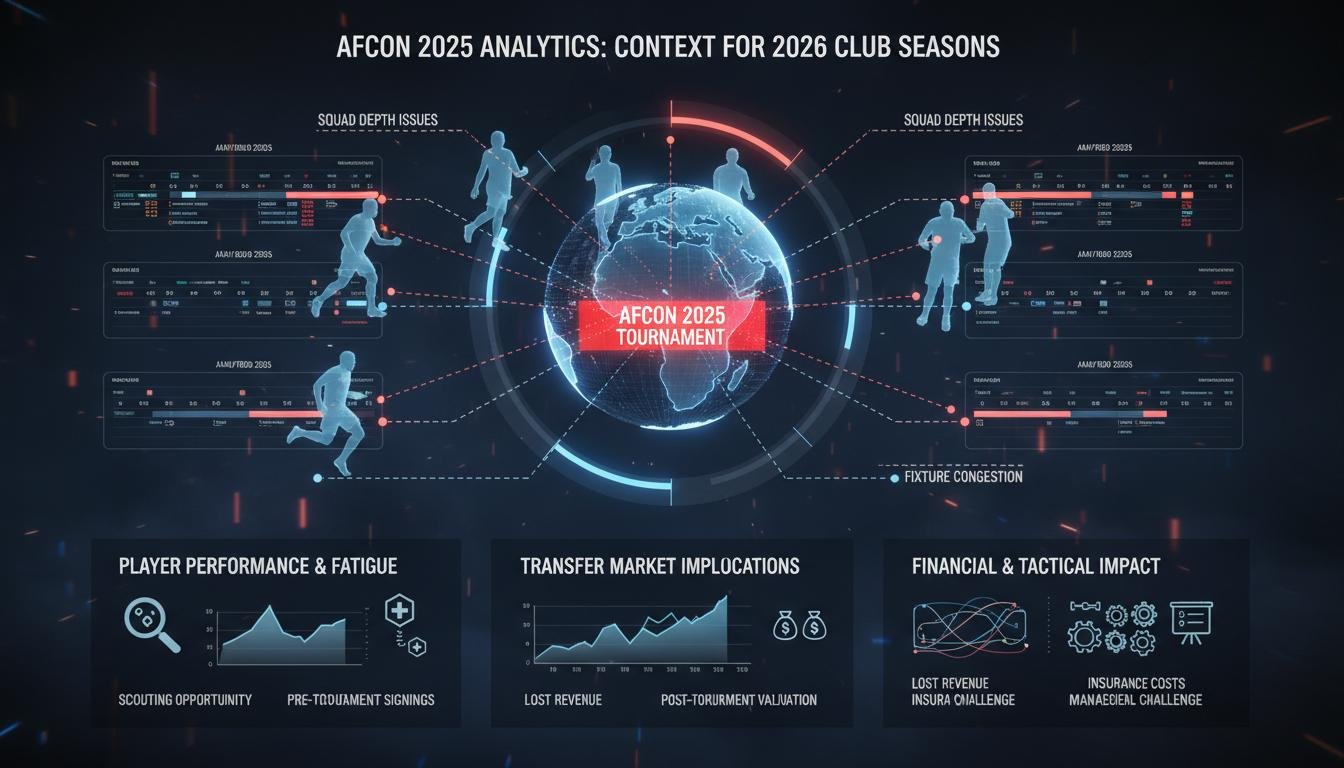
The Africa Cup of Nations 2025 rewired the scouting maps, altered transfer valuations, and delivered a fresh dataset that club analysts will be mining through the 2026 campaign. This article breaks down what the numbers from AFCON 2025 mean for clubs, managers, and sporting directors preparing for a long, complex season ahead.
Why AFCON 2025 matters beyond the trophy
AFCON has always been more than a continental title; it is a concentrated, high-intensity lab of player performance under pressure. For many players, the tournament creates an atypical midseason spike in minutes and exposure, and those patterns ripple directly into workloads, market value, and tactical planning at club level.
Clubs often underestimate the cascading effects of a summer or winter AFCON on squad dynamics. When a handful of regular starters return with extra minutes, fatigue, or injuries, rotation strategies shift, youth players are promoted sooner, and tactical blueprints are tweaked to cover for lost capabilities.
Beyond the physical toll, AFCON 2025 supplied fresh behavioral and event data—pressing intensity, progressive carries, build-up involvement—that changes how clubs view players whose club roles had been limited or misread. In short, the tournament produced actionable intelligence, not just headlines.
Key analytic themes from AFCON 2025
Three threads dominated the analytics conversation at AFCON 2025: workload distribution, positional versatility revealed under tournament constraints, and the defensive transition data that contradicted pre-tournament scouting notes. Each of these is immediately salient for clubs entering the 2026 season.
Workload distribution shows which players accumulated disproportionate minutes across qualifiers and the tournament, and which reached peak exertion levels likely to require managed returns. That helps medical and performance teams plan individualized reintegration schedules rather than default rest blocks.
Positional versatility emerged as a major scouting signal. Several players who were nominal wingers at club level logged significant minutes centrally or as inverted fullbacks, demonstrating transferable cognitive and motor skills. Clubs tracking role flexibility can opt for fewer specialist signings and focus on multipositional assets.
Workload and injury signals
AFCON 2025 generated a clear signal set for injury risk models: cumulative minutes across domestic leagues, continental play, and the tournament correlated strongly with soft-tissue injuries in the six months that followed. The pattern isn’t new, but the magnitude for certain teams was notable and measurable.
Sports science teams should treat AFCON minutes as a discrete variable when feeding load-management algorithms. Instead of lumping tournament minutes with league minutes, separate weighting provides better post-tournament return-to-play predictions and reduces false negatives in readiness assessments.
Revealed tactical tendencies
Clubs examining sequence data from AFCON 2025 found quicker transitions from defensive third to third-third than seen in many European domestic matches. That implies players who performed well in those fast sequences may be undervalued by clubs whose scouting lenses prioritize possession metrics.
Similarly, pressing events per 90 minutes and successful counterpress metrics from AFCON can identify midfielders and forwards who excel in high-tempo systems. Clubs with a pressing identity should re-evaluate players who posted above-average tournament metrics even if their pass completion looked ordinary.
Psychology and performance under pressure
Tournaments compress pressure into short windows; clutch performance metrics—successful high-leverage passes, defensive interventions in the final 15 minutes, and successful penalties—become predictive signals for mental robustness. Clubs competing in knockout competitions can use these indicators for roster construction.
Behavioral analytics built from AFCON moments help separate technically good players from those who reliably deliver in late-game, high-stress moments. Coaching staff should integrate these signals with psychometric testing to create more resilient training plans.
Measuring player risk and market value after AFCON
AFCON 2025 changed market narratives. Players who exceeded expectations saw immediate bumps in interest and valuation, while those who picked up injuries or poor fitness profiles saw clubs reprice risk. Understanding how to translate tournament output into market value requires a blend of on-field metrics and macro transfer-market data.
Clubs should consider building a two-axis valuation model: one axis for output (goals, assists, progressive actions, defensive actions) adjusted for league strength and minutes, and a second axis for availability (injury history, accumulated minutes, recovery markers). AFCON minutes and conditioning markers should be a multiplier on the availability axis.
Insurance and contract strategies also change after AFCON. Sporting directors may negotiate conditional clauses tied to tournament appearances or adjust amortization schedules to reflect short-term market interest spikes. Clubs with refined valuation frameworks can spot overpriced reputational bids versus genuinely sustainable upgrades.
| Analytic measure | Why it matters to clubs | How AFCON influences it |
|---|---|---|
| Cumulative minutes | Availability and fatigue risk | AFCON adds concentrated minutes and travel |
| Progressive actions/90 | Offensive contribution in open play | Tournament performance reveals system fit |
| Pressing effectiveness | Suitability for high-intensity systems | Tournament heatmaps highlight pressing impact |
| Injury probability index | Contract and rotation planning | AFCON load raises short-term probability |
Transfer window implications for 2026 club seasons
The weeks after AFCON 2025 are a strategic pressure cooker for transfers. Clubs can be reactive, driven by market demand for breakout players, or proactive, using tournament insight to target undervalued candidates. Both paths have risk and opportunity.
For clubs with smaller budgets, AFCON is an inventory source. Players from less-scouted domestic leagues who performed well in the tournament become realistic targets before a major market cascade. Those clubs should fast-track data sharing between scouting, analytics, and the board to close deals quickly.
Big clubs often face a different decision: buy the tournament star at a premium or invest in depth, anticipating post-AFCON fatigue in other squads. The smart move frequently blends both—securing a primary target while rotating aggressively in the first months of the season.
Practical negotiation levers
- Use conditioning and medical reports from AFCON as negotiation points—clauses for post-tournament assessment and phased integration can reduce transfer risk.
- Leverage performance microdata (xG buildup involvement, passing lanes created) to build valuation arguments that go beyond headline goals and assists.
- Consider loan-to-buy structures for players returning from heavy AFCON workloads to allow staged performance evaluation.
Squad management and rotation strategies informed by AFCON data
Clubs that plan well will implement individualized return-to-play windows and tactical easing of minutes. This is not one-size-fits-all: a central midfielder with high pressing involvement may need a different ramp-up than a winger reliant on explosive sprints.
Coaches should communicate expected reintegration timelines publicly and privately to manage both fan expectation and internal dynamics. Transparency helps reduce panic-driven overuse of fringe players and ensures that rotation aligns with analytical forecasts rather than emotional reaction.
Youth pathway planning benefits too. AFCON 2025 showed many under-23 players stepping into major roles mid-tournament. Clubs with structured development plans can promote these players into specific roles instead of splurging on short-term signings, which preserves long-term squad cohesion.
Case studies: players and clubs to watch
Examining real AFCON 2025 cases makes the analytics tangible. Consider a midfielder who came from a mid-table European side and posted top-quartile pressing success and progressive carries during the tournament. That player’s club should examine whether their tactical model can exploit those traits and project minutes accordingly.
Another example: a defender who returned from AFCON with cumulative load higher than his club-season baseline and a minor soft-tissue issue. Integrating that player’s AFCON recovery data into the club’s medical timeline can avoid re-injury and maintain continuity across competitions.
In my experience working with clubs as an analyst, we once used tournament sequence data to reposition a fullback as a box-to-box midfielder. The decision was supported by carry and progressive pass data extracted from a continental tournament, and the player delivered immediate value in the domestic season following careful load management.
Integrating AFCON analytics into season planning: a practical roadmap
Clubs should adopt a three-stage process: immediate assessment, medium-term integration, and continuous monitoring. Immediate assessment captures minutes, injuries, and behavioral flags. Medium-term integration adjusts tactical plans and contracts. Continuous monitoring tracks return-to-play trajectories.
Step 1: Within 48–72 hours of a player’s return, capture raw event data, GPS workload metrics, and medical scans. This feed should update a player’s availability index that integrates into match selection models.
Step 2: During preseason, simulate match minutes using microcycle loading templates calibrated by AFCON outputs. Run risk-reward simulations for each competitive window in the 2026 season to prioritize competitions and manage squad depth.
Step 3: Use continuous monitoring to refine predictions. If a player exceeds expected recovery metrics, gradually increase exposure; if not, trigger alternative plans such as tactical reshuffles or transfer market interventions.
Data governance and sharing
To make AFCON analytics useful, clubs must have clear data governance. That means standardized event naming, consistent GPS labelling, and secure pipelines between performance, medical, scouting, and analytics teams. Disconnected data creates faulty models and misinformed decisions.
Clubs should also create a short-format AFCON dossier template for each returning player. The dossier includes tournament minutes, high-intensity runs, recurring discomfort reports, and tactical role shifts. This accelerates decision-making in transfer meetings and match week squads.
Scouting and analytics tools to prioritize
Not all data is equally valuable. For AFCON-derived insight, prioritize event sequencing, GPS-derived load, and pressure maps. These measures best capture the contextual demands players faced and how those demands compare to club expectations.
Tools that enable cross-context normalization are essential. Comparing progressive passes in AFCON versus a top-5 European league requires model-driven adjustments for tempo, pitch quality, and opposition structure. Invest in tools that already support league-strength normalization to avoid reinventing the wheel.
Finally, ensure scouting reports are enriched with video clips aligned to the event data. The human eye must verify algorithmic signals. A pressing metric without visual context can lead to misinterpretation and poor recruitment choices.
Policy and scheduling conversations clubs should pursue
AFCON’s calendar overlap with domestic calendars will continually pressure clubs. Sporting directors should engage national federations and CAF representatives to advocate for scheduling transparency and for the distribution of windows that reduce midseason disruption.
Clubs might also lobby for clearer medical data sharing protocols from international tournaments. If a player’s scan or diagnosis is captured at an AFCON medical center, an agreed-upon data transfer can accelerate accurate reintegration and reduce disputes over player fitness post-tournament.
What to watch in the early months of the 2026 club season
Performance analysts should focus on three early indicators: minutes tapering, substitution patterns, and erratic form. These can signal how well players who participated in AFCON are integrating back into club life. Early detection enables corrective rotations before critical matches.
Watch transfer corridors too. The immediate three-week window after AFCON typically sees a spike in offers and counteroffers. Clubs that have pre-built valuation frameworks will navigate this period more efficiently and avoid overpaying for narrative-driven signings.
Practical checklist for clubs
To synthesize the article into usable steps, clubs should adopt this checklist: capture and normalize AFCON minutes, run individualized risk models, update tactical fit matrices, adjust contract and insurance terms, and integrate monitoring into the daily performance dashboard.
- Normalize AFCON data against league baselines.
- Prioritize GPS and soft-tissue injury monitoring post-tournament.
- Use role-flexibility metrics to re-evaluate squad depth.
- Create phased reintegration plans for returning players.
- Leverage tournament exposure to accelerate scouting for cost-effective targets.
Final thoughts on long-term implications
AFCON 2025 left behind more than medals: it provided a data-rich springboard for smarter roster decisions and deeper tactical insight. Clubs that translate those episodic tournament signals into durable analytics practices will enter the 2026 season with a clearer edge.
Successful integration requires humility—accepting that tournament metrics are noisy—and discipline—creating robust pipelines that turn that noise into predictive signals. Done correctly, AFCON data refines recruitment, protects player health, and sharpens competitive strategy across a club’s entire football operation.
Sources and experts consulted:
- Confederation of African Football (CAF) — Official match reports and tournament data
- Stats Perform / Opta — Event and sequence data analytics
- StatsBomb — Tactical and pressing analytics
- Wyscout — Scouting video and event integration
- Transfermarkt — Transfer values and market movements
- CIES Football Observatory — Market valuation research
- KPMG Football Benchmark — Industry reports
- FIFA — International calendar and regulation guidance
- FiveThirtyEight — Sports analytics perspectives and modeling
- The Athletic — Match reports and tactical analysis (various authors)
Full analysis of the information was conducted by experts from sports-analytics.pro