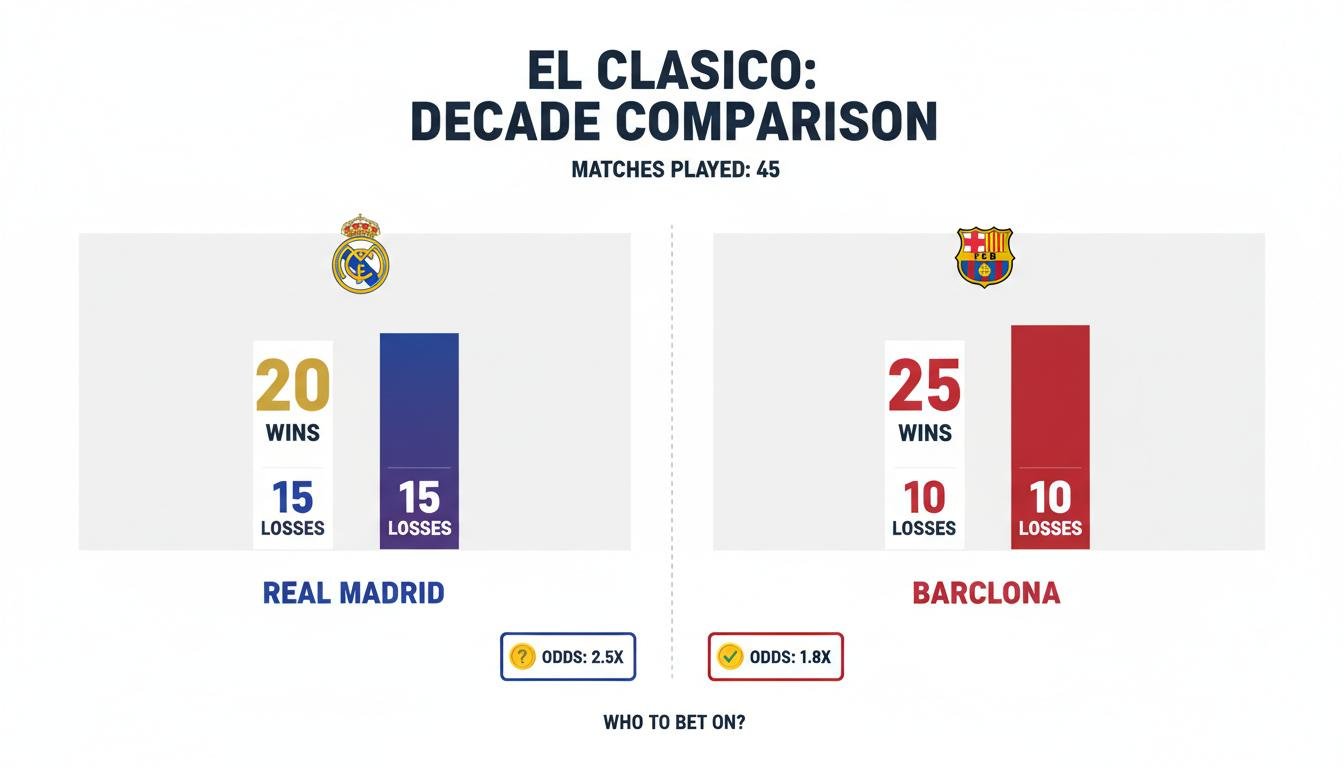
Few fixtures carry as much weight in football as El Clásico, and over the last ten years that match has been a barometer for shifting power, tactical fashions, and transfer-market fever. In this piece I compare the decade-long trends between Real Madrid and Barcelona, translate them into betting-relevant insights, and offer practical scenarios to consider before staking money on one side or the other.
the decade at a glance: momentum, trophies, and turning points
The period from roughly 2014 to 2024 is best described as a sequence of momentum swings rather than sustained dominance by a single club. Real Madrid enjoyed a golden run in the mid-2010s — multiple Champions League titles and a deep squad — while Barcelona rode the Lionel Messi era until his departure in 2021, collecting domestic trophies and playing a possession-driven brand of football.
After those peaks came structural change. Coaching turnovers, major departures (including Cristiano Ronaldo from Real in 2018 and Messi from Barcelona in 2021), and the growing influence of younger stars reshaped both clubs. By the late 2010s and early 2020s, financial realities and squad rebuilds meant neither side had permanent supremacy; results reflected form, transfers, and tactical shifts week to week.
head-to-head rhythms: what the results reveal
Over the decade, head-to-head matches were intensely competitive. Neither club consistently won El Clásico by comfortable margins; many fixtures were decided by fine margins — set pieces, a counterattack, or a penalty — rather than one-sided routs. Home advantage mattered, but not decisively: both teams produced surprise away victories.
What stands out in the data is variability. There are stretches where Barcelona dominated possession and territorial control, and stretches where Real Madrid punished them with superior transition finishing and clinical chance conversion. If you scan match reports from reputable databases you’ll see patterns emerge: Barca often controlled expected possession and short-passing metrics, while Real tended to outscore them on high-quality chances and set-piece effectiveness.
statistical edges: attack, defense, and the analytics picture
When comparing attacking metrics, Barcelona typically generated more progressive passes and higher possession percentages in most seasons, translating into sustained pressure. Real Madrid’s attacking output often relied on fewer, higher-quality chances and excellent shot conversion in decisive moments.
Defensively, both teams experienced highs and lows depending on personnel and coaching. Real’s defensive resilience in key seasons came from robust organization and experienced backlines, while Barcelona’s defensive stats improved when they combined pressing intensity with a disciplined back four. Advanced metrics such as expected goals (xG) and shots on target tell a similar story: Barcelona frequently out-posed opponents, Real frequently optimized the chances they did create.
influence of transfers and personnel: players who moved the needle
Transfers and player development shaped outcomes more than schematic slogans. Cristiano Ronaldo’s exit in 2018 and Messi’s departure in 2021 were seismic; they forced tactical overhauls and redistributed goal-scoring responsibilities. Emerging stars — Vinícius Júnior on Real’s left, and the arrival of Robert Lewandowski at Barcelona in 2022 — shifted attacking profiles and betting market perceptions.
Goalkeeper and defensive signings also mattered for bettors. A newly signed center-back or keeper can alter the expected goals conceded number, which in turn affects markets like under/over goals and clean-sheet specials. When you bet, check how recent acquisitions have performed in domestic and European competition rather than relying on name value alone.
tactics and match types: how style affects betting markets
Tactical identity changes the type of bets that offer value. A Barcelona side set on possession usually leads to lower early-game volatility: fewer rapid counters, more sustained build-up, and betting markets that favor under/over totals shifting toward lower numbers. Conversely, Real’s effective transition play generates sudden spikes in expected goals and creates in-play opportunities for bettors willing to act fast.
Set pieces are another underappreciated angle. Across the decade, set-piece goals and penalties decided a meaningful portion of El Clásico outcomes. That makes markets tied to corners, fouls, or players likely to score from dead-ball situations worth watching, provided you verify recent set-piece conversion rates and the designated takers.
betting strategies: where to find value
Match-winner markets on El Clásico are efficient and heavily priced; sportsbooks know the fixture attracts casual and professional money. Instead of treating straight win/loss as the only option, consider alternative markets that reflect the statistical edges above. Asian handicap can protect you from a close loss, while both-teams-to-score (BTTS) often offers fair value given the open nature of many clashes.
Timing is crucial. Pre-match odds shift as lineups, injuries, and weather appear. In-play markets can be profitable because tactical transitions often create clear short-term edges — for example, if Barcelona dominates possession without scoring, an in-play BTTS or under/over adjustment might offer value when the market hasn’t fully priced the impending tactical change.
sample betting scenarios
Scenario 1: Barcelona has home advantage, full-strength midfield, and recent higher possession metrics. Favor: under/over—consider under if both teams are settling and key forwards are absent; consider BTTS if both full-strength attacks are present. Use smaller stakes on match winner.
Scenario 2: Real is fresh from a good run, Barcelona has injuries to wide defenders, and Real’s forwards have high recent shot conversion. Favor: Asian handicap in favor of Real or a smaller stake on Real match-winner; look for first-goalscorer markets that reflect an in-form striker.
Scenario 3: Both sides field rotated squads due to European commitments. Favor: under goals and cautious small stakes; such matches are often less open and offer limited upside in match-winner markets.
risk management and practical tips before you click place
Check final lineups, weather, fatigue (number of days since last match), and referee history. Small factors like a key midfielder suspended or a travel-heavy schedule can swing an already-tight fixture. Follow verified injury reports from club sites and reputable reporters rather than social media rumors.
Bankroll management matters. With volatile fixtures like El Clásico, use lower unit sizes and consider hedging in-play if the fixture moves against you early. Keep a log of bets and rationales; over time this will reveal which markets you read best and where your edge actually lies.
a personal note from the stands
I once watched a Clásico from a bar in Madrid where the atmosphere flipped in a single counterattack; that in-game momentum translated to a flurry of profitable in-play lines for bettors who reacted calmly. The lesson was simple: emotion and crowd noise distort perceived probability. Successful betting requires detaching from spectacle and reading the hard signals — lineups, recent form, and statistical indicators.
When you prepare for a Clásico wager, treat it like any other investment. Do the homework, size your stake to tolerance, and don’t chase losses after a wild 90 minutes. If you follow those simple rules, you’ll make smarter choices across seasons.
Below are authoritative sources I consulted and recommend for up-to-date statistics, head-to-head records, and advanced metrics. Bookmark them and verify data before placing bets.