Fouls are one of those market niches that look dull on the surface but carry hidden value when you know what to watch. This article unpacks how the total-fouls market works, which data points move the needle, and how to turn a disciplined approach into a consistent edge. I’ll mix practical rules, a simple model, and examples from my own betting experience so you can start testing ideas right away.
How the total-fouls market works
Bookmakers offer totals for combined fouls in a match or for each team, typically as an over/under line. The bookmaker sets a line based on expected foul counts and then adjusts for liability, so the publicly available line already contains market-inferred expectations and margin.
Understanding what constitutes a foul is important because not every physical contact is counted the same, and different referees have different enforcement thresholds. The IFAB Laws of the Game define fouls and misconduct, which informs how referees interpret incidents on the pitch and therefore how many fouls are recorded.
Which variables actually drive foul totals
Foul counts are not random; they respond to tactical choices, referee personality, match context, and external conditions. The most impactful variables are referee tendencies, team playing styles, the importance of the match, and early game events such as an early card or injury.
Weather and pitch conditions matter too because slippery surfaces and wind change tackling timing, leading to more stopped play and potentially more fouls. Crowd intensity and derbies often ratchet up physicality; historical foul averages for these fixtures tend to be higher than neutral games.
Referee profiling
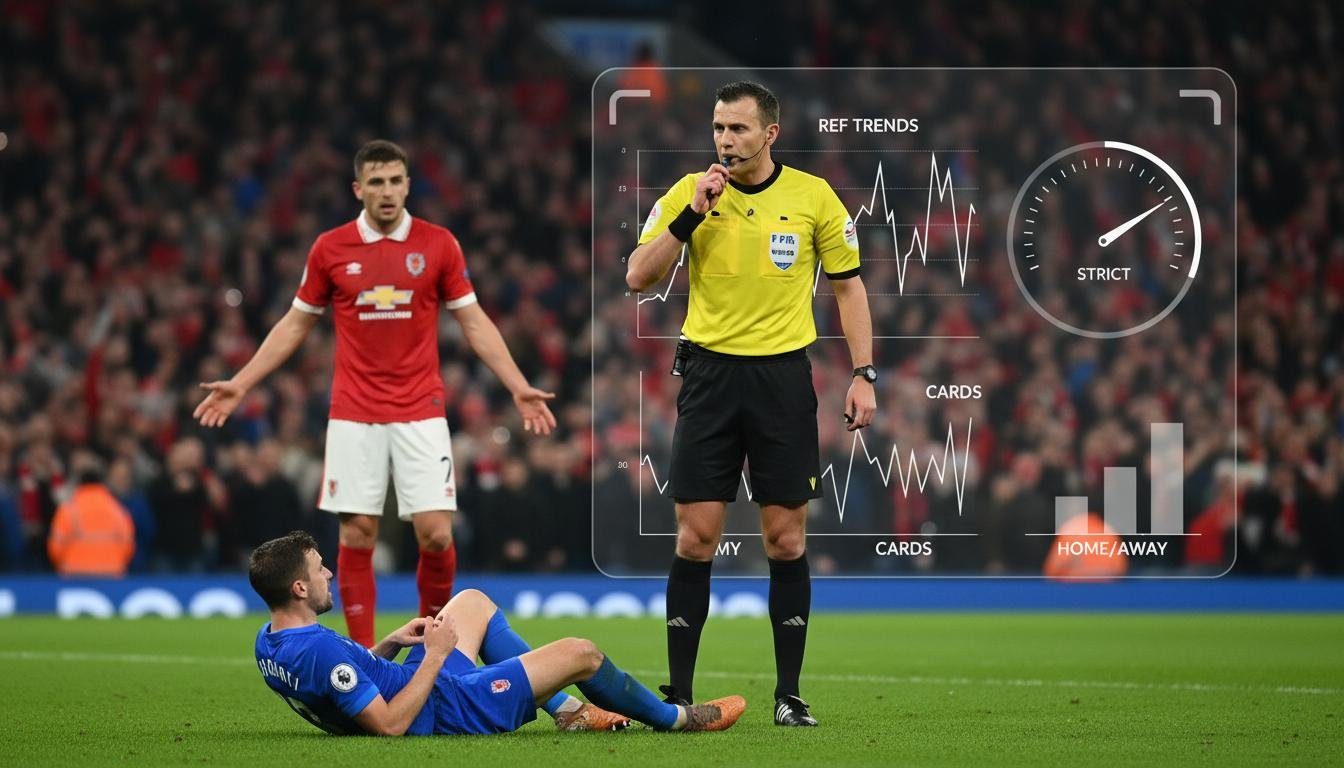
Referees are the single biggest single-game factor. Some refs call the game tightly and award many fouls; others allow more contact and favor advantage play. Use referee averages for fouls per game and card frequency as a baseline when comparing lines.
Many leagues publish referee statistics and sites like FBref and league official stat pages include foul-related metrics; build a small referee database so you can quickly compare the referee on duty to the market line. In my experience, tagging a handful of referees who consistently exceed or fall below the league mean is a high-value shortcut.
Team tactics and matchups
Certain tactical profiles correlate with foul rates: high-pressing teams tend to commit more fouls as they challenge possession, while teams that play long possession and slow tempo typically register fewer infractions. Matchups where both sides press intensely often produce over-lines.
Context matters: a defensive team facing a far superior opponent might choose to foul tactically to stop attacks, increasing totals. Conversely, when two technically superior, possession-focused teams meet, a lower foul count is common.
Data you should check before placing a bet
Make a short pre-match checklist: league average fouls per game, each team’s fouls committed and suffered per 90, the assigned referee’s foul and card averages, recent form (last 5–8 games), and head-to-head historical fouls. These items together reveal whether the market line is high, low, or fair.
Shop for lines across several bookmakers and exchanges. Small differences of 1–1.5 fouls in the posted line can change whether a bet has value, and because market movement often reflects public money rather than new information, early lines sometimes offer the best edges.
Simple expected-fouls model (illustrative)
A lightweight model combines team fouls per game and referee average into an expected total. For example: expected fouls = (home team fouls per game + away team fouls per game) / 2 adjusted by (referee fouls per game − league average) * 0.5. This gives a quick sense whether the book’s line is mispriced.
Here’s a brief example to make it concrete. If Team A averages 12 fouls, Team B averages 11, and the referee averages 28 fouls while the league average is 25, the calculation yields roughly 23.5 expected fouls — letting you compare that to the offered over/under.
| Input | Value |
|---|---|
| Team A fouls per game | 12.0 |
| Team B fouls per game | 11.0 |
| Referee fouls per game | 28.0 |
| League average referee fouls | 25.0 |
| Expected fouls (illustrative) | 23.5 |
Live betting advantages and timing
Live markets for fouls can present value because early minutes reveal the referee’s style for that match and how players are being managed. If a referee issues a strict early card or penalizes minor contact, anticipate a higher foul rate and adjust your live bets accordingly.
Timing matters: the first 20–30 minutes often establish match tempo, and lines will move quickly after an early event. I often watch the first 15 minutes before committing to an over/under foul total unless pre-match data already suggests a strong edge.
Money management and stake sizing
Betting fouls is no different from other specialty markets: bankroll management is crucial. Use a fixed percentage model like 1–2 percent of your bankroll per edge bet, and reduce stakes on markets where your confidence is lower or sample sizes are small.
Keep records. Over months you’ll see which referees and team matchups produce repeatable edges for you. I track bets by referee, league, and stake size; this simple discipline turned small wins into a meaningful long-term ROI in my own portfolio.
Common mistakes and how to avoid them
Don’t overreact to single-game outliers: one match with unusually few or many fouls doesn’t change long-term probabilities. Avoid chasing lines when public sentiment skews markets after a headline event like a derby or a controversial decision.
Be wary of conflating cards with fouls. A game with many fouls does not always have many yellow cards, because referees may opt to play advantage or issue cautions selectively. Treat foul totals as a distinct market and evaluate it on its own metrics.
Practical pre-match checklist
- Check referee fouls and card averages vs. league baseline.
- Compare both teams’ fouls per game and fouls suffered per game.
- Note recent match tempo, injuries, or news affecting physicality.
- Shop lines across multiple bookmakers for the best over/under.
- Decide stake size based on confidence and bankroll rules.
- Consider live watch for the first 15–30 minutes before committing where appropriate.
Final practical tips from experience
Start small and keep a log. The fouls market rewards consistency and a calm, data-driven approach more than flashy single bets. Early in my own play I kept stakes tiny while I learned which referees reliably diverged from market expectations.
Be patient. Edges in fouls are often modest but steady, and they compound when paired with disciplined money management. Treat this market like a specialty tool in your betting toolbox — useful and profitable if used correctly, but not a cure-all for reckless staking.
Sources and further reading
- IFAB — Laws of the Game: https://www.theifab.com/
- Premier League statistics (fouls): https://www.premierleague.com/stats/top/clubs/fouls
- FBref (team and player stats): https://fbref.com/
- Pinnacle — soccer betting resources: https://www.pinnacle.com/en/betting-articles/soccer
- UK Gambling Commission (responsible gambling guidance): https://www.gamblingcommission.gov.uk/