Betting on individual team card totals is a niche within football wagering that rewards preparation and patience more than bravado. Rather than guessing which side will score, you’re forecasting discipline, refereeing style, and tactical nastiness — all quantifiable and, with the right approach, exploitable. This article walks through what matters, how to model it, and practical tactics you can apply before kickoff and in-play.
What an individual team card total market actually measures
When a bookmaker posts an individual team total for cards they are offering a line on how many cautions or dismissals a single team will receive during a match. Lines are usually expressed as over/under for yellow cards, sometimes combined cards (yellow + red), and less commonly red-only markets. Asian-style card lines and card handicaps are also available and behave similarly to goal handicaps in terms of settlement and value.
Understanding settlement rules is crucial: some sportsbooks count two yellows as a red, others treat each event separately, and extra time rules vary between competitions. Before you bet, always check whether the market includes stoppage time, extra time, and whether disciplinary actions post-match (like retrospective bans) are excluded.
Key data points to analyze
Start with the team’s historical card rate: yellow cards per 90, red cards per season, and fouls conceded. Opta-style event data and platforms like StatsBomb provide play-by-play records that let you normalize for minutes and competition level. These raw counts are your baseline and are best measured over both long-term (last two seasons) and short-term (last five to ten matches) windows to capture form shifts.
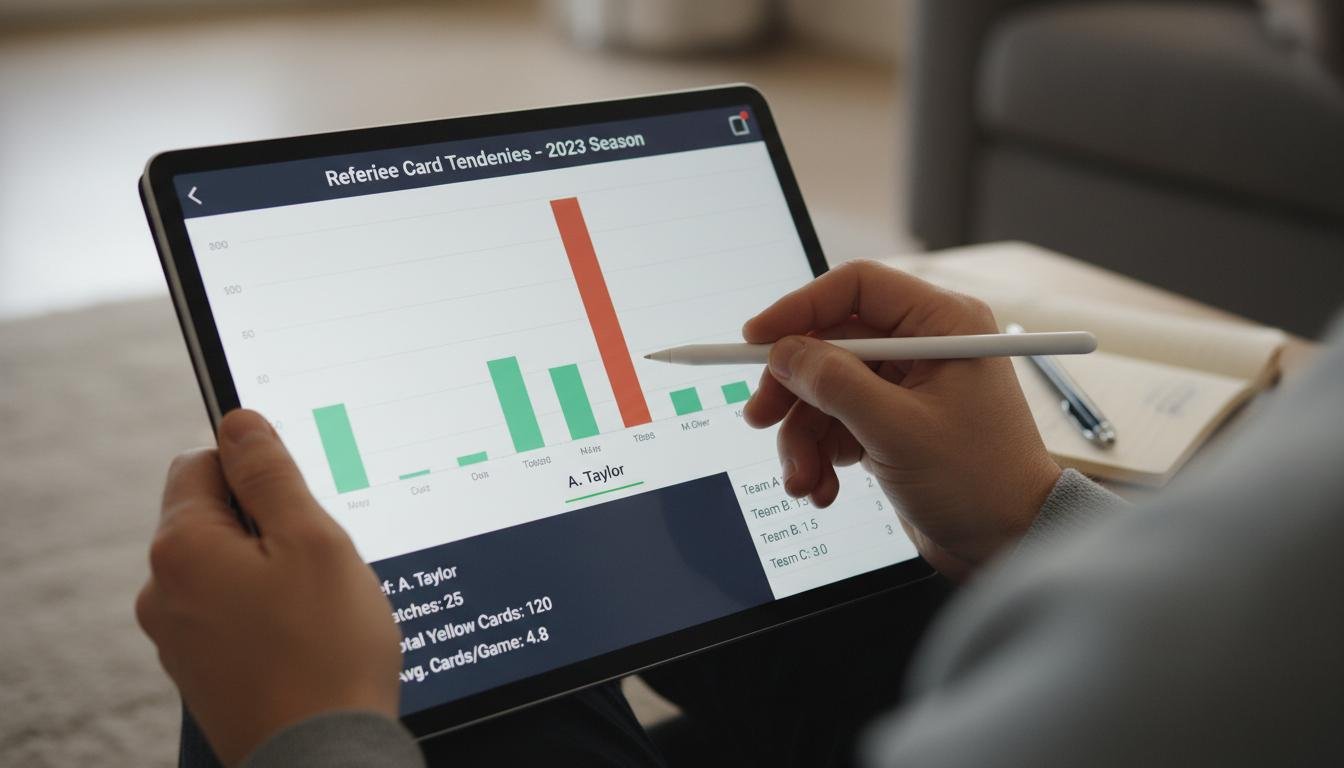
Referee tendencies are equally important. Some referees hand out cards quickly, others let the game run. Referee-specific card rates and the number of fouls allowed before a card are available for many leagues, and they change the expected total dramatically. Game context — rivalry intensity, table position, and knockout vs. league format — also shifts card probabilities in predictable ways.
Pre-match strategies: finding edges before kickoff
A disciplined pre-match strategy combines team and referee profiles into an expected cards estimate and compares that to the bookmaker’s line. I like to weight referee propensity around 30–40 percent, team discipline 40–50 percent, and context (weather, injuries, importance) the remaining 10–30 percent depending on how meaningful the match is. This blend produces a target number you can compare to the market.
Look for market inefficiencies. Lines move when public money skews perceptions, or when last-minute team news changes the outlook. Value often appears when a commonly favored team is priced with an inflated card total because bettors assume dominance equals aggression. Contrarian plays, backed by data, can be profitable.
In-play tactics: timing and momentum
Live markets offer the most opportunity if you can watch the match and react. Early-match dynamics matter: a referee showing a single yellow in the first 10 minutes often signals a card-happy game; conversely, a lenient opening can push totals down. I typically wait for the first 20 minutes to gather information unless pre-match analysis gave a strong directional read.
When a team is down a player or a yellow has cautionary effect, card probabilities change fast. Betting overs on a team that is protecting a lead and likely to foul can be counterintuitive but effective in matches where the trailing side will press and commit tactical fouls. Conversely, if a team receives an early red, consider hedging or cashing out since variance explodes after dismissals.
Modeling cards: practical, not academic
You don’t need a PhD to build a useful model; a simple negative binomial or Poisson framework adjusted for referee and context works well for card counts. Cards are overdispersed compared to goals, so the negative binomial often fits better. Use historical matches to estimate base rates and then adjust for referee factor and match weight.
Key variables to include: team yellows per 90, opponent provocation (how many fouls the opponent draws), referee cards per match, home/away bias, and game importance. More advanced models add player-level tendencies and tactical indicators like average tackles in the final third. Backtest using several seasons and always hold out a sample for validation.
A small table to clarify model inputs
| Input | Why it matters |
|---|---|
| Team yellows per 90 | Baseline discipline and likelihood to be booked |
| Referee cards per match | Referee strictness strongly shifts expected totals |
| Opponent fouls conceded | Indicative of match friction and pressure |
| Game context | Rivalry, knockout stakes, weather can elevate fouling |
Staking and bankroll management
Discipline matters off the pitch as much as on it. Use flat stakes for exploratory bets and move to a proportional staking method like fractional Kelly only after you have a validated edge. Cards are noisy: many small wins will be followed by long losing stretches, so plan for variance.
Set a maximum exposure per match (for example, 1–2 percent of your active bankroll) and limit correlated bets across multiple matches to avoid catastrophic runs. Track wins and losses by market type to refine which card markets you handle best over time.
Common pitfalls to avoid
Small sample sizes and recency bias are the most frequent traps. Teams might accumulate cards in a short burst due to a tactical shift or a single aggressive opponent, and extrapolating from three matches will mislead you. Always blend long and short windows to balance persistence and recency.
Another mistake is underestimating lineup news. A single player with a history of bookings being absent or suspended can change an individual team total materially. Also, don’t assume bookmaker lines are always immovable; sharp moves from respected markets can signal genuine information and not just noise.
Real‑life example from my betting experience
In one season I tracked a small subset of matches where a high-card team faced a referee with an above-average caution rate. I placed conservative, value-size bets on team overs and logged outcomes. The edge was not large but consistent, and over several months those modest wins added up while learning opportunities for refining the model emerged.
That experience taught me that patience and record-keeping are where long-term profit comes from, not flashy parlays. It also reinforced the practical value of combining quantitative measures with on-the-ground watching of matches.
Practical checklist before placing a bet
- Confirm market settlement rules and whether stoppage time counts.
- Check referee card history for the fixture.
- Review both teams’ card rates over long and short windows.
- Assess team news for disciplinary or tactical changes.
- Decide staking size and whether the bet fits your portfolio.
Responsible approach and continuous learning
Success in team card betting is incremental. Treat every wager as an experiment: record the rationale, the size, the outcome, and what you learned. Over time you’ll spot patterns that raw intuition misses and reduce losing variance through better market selection.
Finally, remember that betting should be recreational and controlled. Use staking rules, set loss limits, and step away when variance stretches you thin. A clear head beats a hot streak every time.
Sources and experts referenced:
- StatsBomb — advanced event data and analysis: https://statsbomb.com/
- Opta / StatsPerform — football event data: https://www.statsperform.com/opta/
- WhoScored — team and player statistics: https://www.whoscored.com/
- Premier League — discipline and match statistics: https://www.premierleague.com/stats
- Pinnacle Betting Resources — articles on betting strategy and staking: https://www.pinnacle.com/en/betting-articles
- Betfair Betting Blog — market insights and trading strategies: https://betting.betfair.com/football/