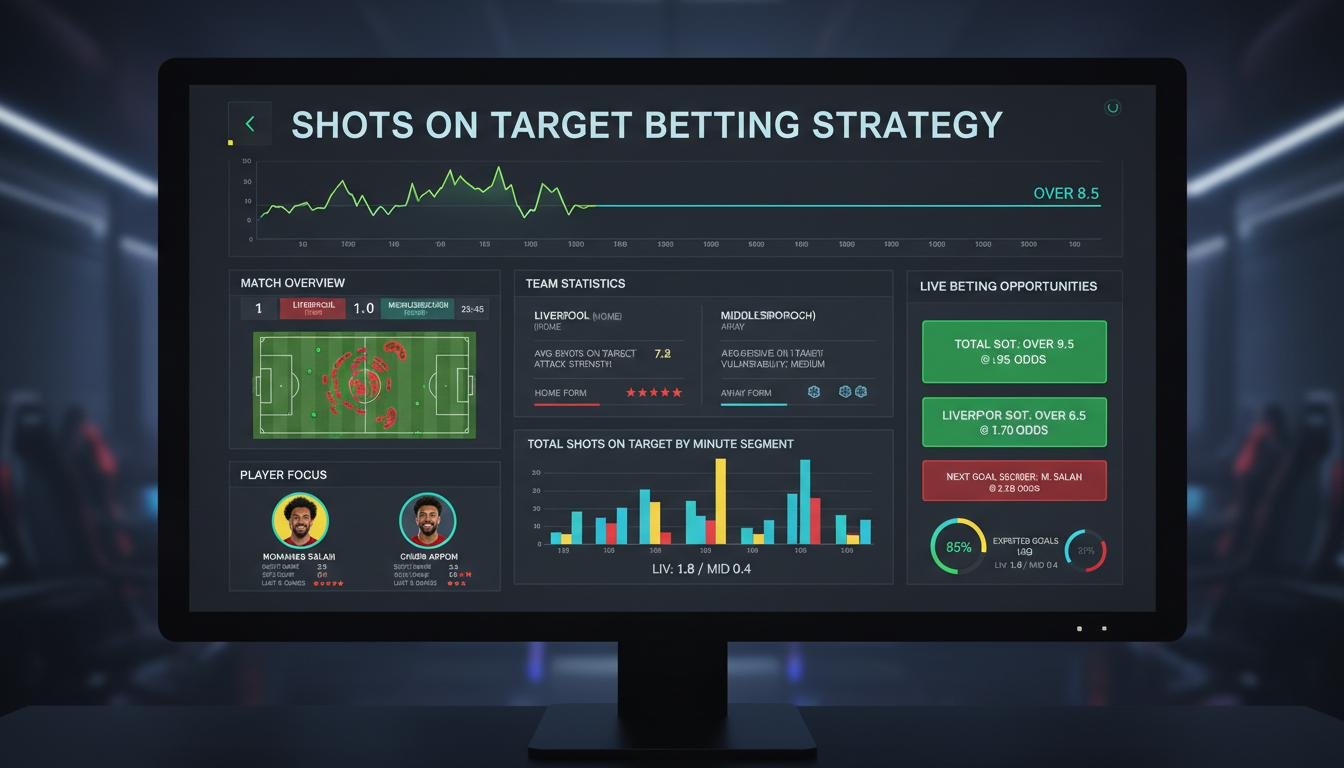
If you’ve ever watched a match thinking a blistering run at goal should count for something even when it doesn’t find the net, shots on target markets can feel like a more honest way to bet on what actually happens on the pitch. This article walks through practical ways to approach those markets—before the whistle and during live play—without drowning in stats or falling for the bookmaker’s noise.
What the market measures and why it matters
Shots on target are a simple, objective stat: attempts that would have gone into the net if not for a save or the goalkeeper’s intervention. Unlike subjective measures such as “big chances,” this count is relatively consistent across data providers and bookies, which makes it useful for modelers and sharp bettors.
Because it ties directly to goalkeeper involvement and attacking intent, the shots on target market often reflects pressing patterns, shot accuracy, and team finishing quality more reliably than raw shot totals. For bettors looking for value, that reliability is a useful foundation.
Reading the market: where value hides
Bookmakers set lines to balance their books, so your job is to find instances where the market misprices a team’s expected shots on target. Common opportunities appear around lineup news, late team changes, or when a goalkeeper with a low save rate is unexpectedly benched.
Value also appears in games where styles clash: a possession-heavy team facing a direct, counterattacking side might register fewer total shots but a higher share of tested goalkeepers. Spotting those style mismatches gives you an edge over bettors who only follow headline form.
Key data and metrics to prioritize
Not all stats are equally helpful. I prioritize (1) a team’s shots on target per 90 minutes, (2) opponent shots on target conceded per 90, and (3) the proportion of shots that are on target—this last one measures accuracy and finishing pressure. Combining these gives a clearer picture than looking at totals in isolation.
Contextual metrics matter too: expected goals (xG), shot locations, and shot-creating actions indicate whether a team is creating high-quality chances or simply peppering the keeper with low-threat attempts. Sources like Opta, StatsBomb, and FBref provide the detailed data that separates a guess from a reasoned bet.
Pre-match filters and red flags
Before you place a pre-match shot market wager, run the game through a short checklist: lineup certainty, goalkeeper selection, tactical continuity, weather, and recent defensive injuries. If more than one key attacker or the first-choice keeper is doubtful, market lines can swing and so can the expected SOT totals.
Red flags include matches with poor data quality (lower leagues where tracking varies), short-suspension lineup announcements, and bookmakers offering strangely wide odds spreads between markets. These often indicate uncertainty rather than opportunity.
- Confirm starting XI at least 30–60 minutes before kickoff.
- Avoid markets immediately after a major lineup shock until you reassess numbers.
- Discount trends based on very small samples (e.g., two matches).
In-play strategies: timing and cues
Live betting on shots on target is where disciplined bettors can extract real value. Early match minutes reveal much: if a team already has multiple shots on target inside the first 15 minutes, the live line for total SOT often lags the actual pace of the game and can be exploited.
Other live cues include substitutions that change attacking intent, a red card that opens up space, and visible tactical shifts—such as a team moving from cautious build-up to aggressive wing play. Watching the game or following a reliable live-feed is essential; in-play markets move quickly and punishingly.
Bankroll and staking considerations
Shots on target bets can be volatile. Use a fixed-percentage staking plan—1–2% of your bankroll per wager is a conservative baseline—and reduce stakes on live bets where momentum can flip fast. Avoid chasing losses by increasing stakes after a bad run; SOT variance can be large in short spans.
For bettors building models, consider using a fractional Kelly approach if you can estimate an edge. For most recreational bettors, flat staking with occasional unit adjustments based on confidence is simpler and psychologically easier to maintain.
Building a simple predictive model
You don’t need a PhD to build a workable shots-on-target model. Start with historical SOT per 90 for both teams, adjust for opponent strength and venue, and add modifiers for injuries and lineup certainty. Backtest the model over several seasons to see whether it approximates closing market lines.
Keep the model transparent and avoid overfitting. Track closing line value versus the market; consistently beating the closing line is the strongest signal you truly have an edge—and it forces you to be honest about when your bets are genuinely predictive rather than lucky.
Common mistakes to avoid
A few pitfalls repeat among bettors: overreacting to a single game’s stat line, ignoring goalkeeper influence, and betting on markets with poor liquidity that widen spreads. Each of these eats into expected returns over time.
Another mistake is relying on brand-name teams alone. Big clubs can dominate possession but still produce a low SOT count against compact defenses. Look beyond reputation and focus on the mechanics that produce shots on target.
- Don’t treat short streaks as sustainable trends.
- Always verify starting XI information.
- Avoid opaque markets with high bookmaker margins.
A brief personal example and checklist
In my own betting, a memorable edge came from tracking a midtable team that consistently produced accurate shots but had been unlucky in finishing. The market priced them as “misfiring,” but their SOT per 90 remained high and their goalkeeper faced many saves. Small, consistent stakes across several matches produced a positive run without dramatic bets.
Use this quick checklist before placing a shots-on-target wager: confirm lineups, check SOT and SOT conceded per 90, evaluate tactical matchup, consider goalkeeper form, and set your stake relative to bankroll. If most boxes are green, you’ve moved from guesswork to disciplined decision-making.
Sources and experts
Opta/StatsPerform — data and event definitions: https://www.statsperform.com/opta/
StatsBomb — advanced event data and analysis tools: https://statsbomb.com/
FBref — team and player per-90 statistics: https://fbref.com/
WhoScored — match ratings and statistical breakdowns: https://www.whoscored.com/
Pinnacle — betting resources and market explanations: https://www.pinnacle.com/
FiveThirtyEight Soccer — predictive models and team forecasts: https://projects.fivethirtyeight.com/soccer-predictions/
Shots on target markets reward careful preparation and calm in-play judgement more than bravado. If you focus on clean data, realistic staking, and disciplined checks, you’ll convert noisy match action into repeatable decision-making—and that’s where sustainable value lives.