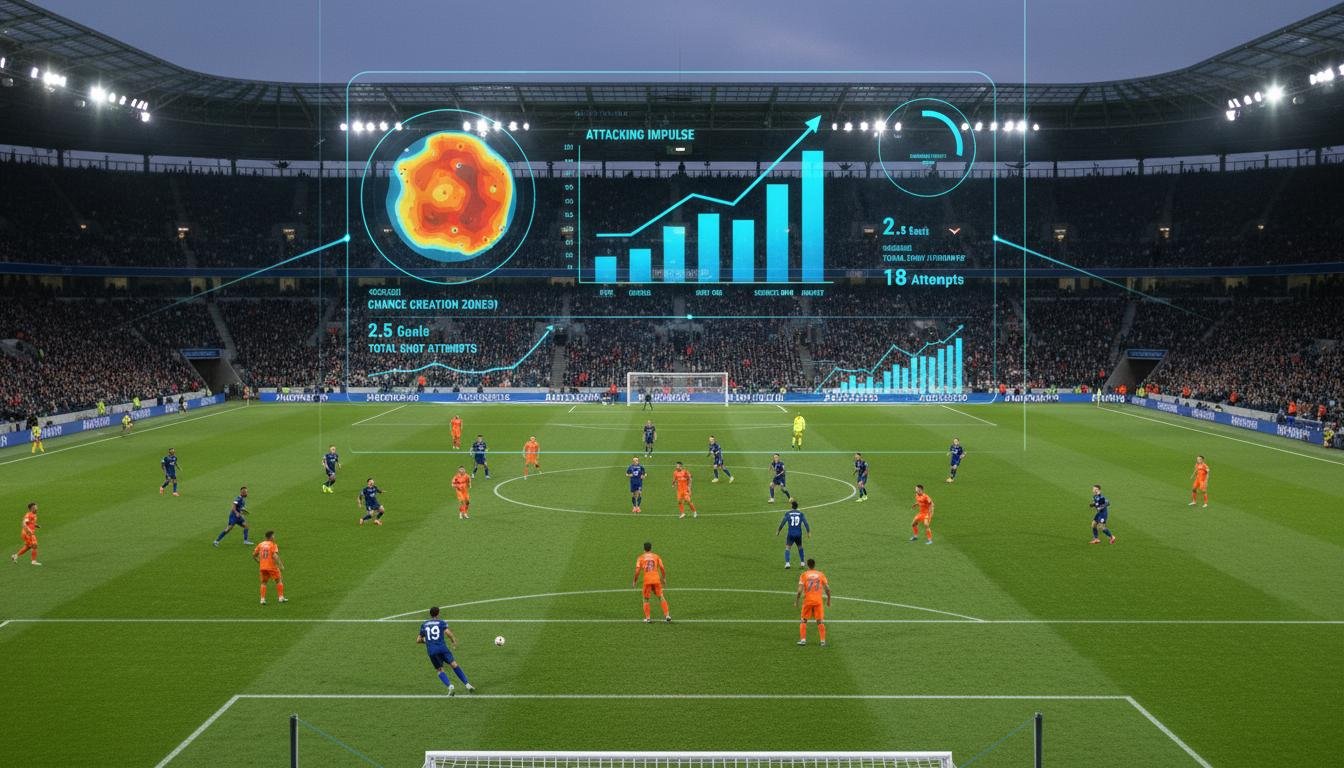
Placing a bet on an individual team’s total goals can feel like both art and engineering: you need a feel for how a team plays and a clear set of observations that predict how many opportunities they will create. This article walks through the practical indicators that signal whether a team is likely to generate lots of chances or grind out a handful of half-opportunities. I’ll mix tactical reading, statistical signs, and real-match examples so you can make smarter pre-match and in-play decisions.
Why chances matter more than final scores
Goals are a noisy outcome. A team could dominate every metric and still leave with nothing because of a hot goalkeeper or an off day in finishing. Betting on an individual team total—whether they’ll exceed a certain number of goals—often rewards traders who focus on process metrics: the underlying chance volume and quality that make goals more likely over time.
Chances are repeatable in ways goals are not. Metrics like shots, touches in the box, and passes into dangerous areas give you a probabilistic edge; over a sample of matches those measures correlate strongly with goals scored. Treat the match as an engine: if the engine’s cylinders (chances) are firing frequently, the chance of putting points on the scoreboard goes up.
Core indicators of chance volume
Not every stat is equally useful. I track a set of core indicators that together give a reliable picture of how many opportunities a team will create. Below is a concise table that summarizes the metrics I prioritize and why each one matters.
| Metric | What it shows |
|---|---|
| Touches in box / penalty area | Direct measure of presence near goal — more touches = more immediate chance potential. |
| Shots (total, on target, from inside box) | Volume and quality of finishing attempts; inside-box shots usually predict goals better. |
| Passes into final third / penalty area | How often a team breaks lines and creates attacking situations. |
| Progressive carries / passes | Measures forward momentum and the ability to move play into danger zones. |
| Big chances / expected goals (xG) | Quality weighting: not all chances are equal, xG approximates conversion probability. |
| Pressing and PPDA | Shows whether the opponent allows time on the ball — lower PPDA from defense often reduces a team’s chance volume. |
Touches in the box and penalty area presence
Touches inside the opponent’s penalty area are among the most reliable short-term predictors of goals. They summarize several attacking processes: successful dribbles, accurate passes, and good positional rotations inside the most dangerous space. When a team averages a significant uptick in penalty-area touches relative to their opponent, lean toward a higher individual team total.
In my own tracking, I noticed a midtable side that suddenly increased their box touches after a tactical tweak to a narrower front three; their shots and goals followed. That kind of tactical cause-effect makes touches in the box actionable rather than just descriptive.
Shots and expected goals (xG)
Count shots, but weight them by location and quality. A flood of long-range efforts inflates shot totals without proportionally increasing goals, whereas several shots from inside the six-yard box are far more meaningful. Expected goals (xG) packages location, angle, and historical conversion into a number that estimates how many goals those chances should produce.
For betting, look at both raw shot volume and xG: high shots with low xG suggests volume without quality, which is riskier for a high-team-total bet. Conversely, moderate shot numbers with elevated xG indicate fewer, but higher-quality, chances — often a safer signal for backing goals.
Passes into the final third and progressive play
Breaking defensive lines via passes or carries explains how a team constructs chances. Modern data providers report “passes into final third,” “passes into the penalty area,” and “progressive passes” that show how frequently a side moves the ball into threatening territory. Consistent success in these events produces repeatable shot opportunities.
Context matters: a team may have many final-third passes but be stopped by a compact low block when opponents sit deep. That’s where combining these indicators with opponent style clarifies whether passes are leading to real danger or just peripheral activity.
Tactical and contextual modifiers you must check
Statistics are powerful, but they’re not independent of match context. Lineups, injuries, tactical shifts, weather, and motivation all shift chance volume. A full-strength attacking unit operating against a low-block opponent will behave differently from the same team missing its creative midfielder or playing on heavy turf.
Pay special attention to lineup announcements. If a team’s usual number 10 is absent and replaced by a deeper runner, expect fewer effective through-balls and progressive passes, which often reduces the projected individual team total. Likewise, late suspensions or high-altitude venues can create outsized shifts in chance creation.
Live betting: reading the early patterns
In-play opportunities open when the early minutes display a trend that the market has yet to price. Watch the first 15 minutes for touches in the box, pass completion in the final third, and whether the opposition allows space. A team piling early pressure against a low PPDA opponent often keeps producing chances, which can be profitable to back before odds adjust.
However, be ready to pivot. A red card, tactical change, or a flurry of counters against you invalidates early signals fast. I’ll often place small, calculated stakes based on the first-quarter pattern and scale up only if the underlying indicators persist into the next phase of the match.
Bankroll management and staking approach
Even a statistically informed edge still carries variance. Use conservative stakes relative to your bankroll and avoid doubling down after a loss. Many experienced bettors use proportional staking methods — flat percentage bets or a modified Kelly criterion — to protect capital while exploiting repeated signals.
Record every trade and note the indicators you relied upon. Over time you’ll see which signals produce consistent returns for specific competitions, teams, or match contexts. That feedback loop is the difference between a promising theory and a repeatable strategy.
Trusted data sources and experts to follow
To apply these indicators properly you need reliable data and expert context. The following resources provide high-quality metrics, explanations, and tactical analysis that are widely used by analysts and bettors alike.
- StatsBomb — deep event data and helpful blog posts on methodology.
- FBref — accessible tables, advanced metrics, and links to underlying event data.
- Understat — xG and shot maps for major European leagues.
- Opta — a leading provider of granular event data used by professionals.
- FiveThirtyEight — model-driven analysis and broader statistical context.
Putting it into practice: a short checklist
Before you place an individual team total bet, run this quick checklist: confirm lineup and tactical setup, compare touches in the box and passes into the penalty area versus season averages, review shot quantity and xG, note opponent pressing intensity, and check weather and motivation. If most indicators point upward — and the market hasn’t fully reflected that — you may have a value opportunity.
Over several seasons of watching matches and tracking these signals, I’ve found that pairing at least three independent indicators (for example, increased touches in the box, rising xG over three matches, and a soft opponent PPDA) yields the best balance of frequency and reliability for higher-team-total bets.
Approach the market like a detective: gather specific, independent clues; understand context; and manage risk. If you do that consistently, betting on individual team totals becomes less about gut feeling and more about disciplined, evidence-based decision making.
Sources and experts
Expert commentary referenced: Michael Caley (expected goals research), Ted Knutson (stats entrepreneurship and methodology). Links to their public work are available via the sites above and related analytics write-ups.